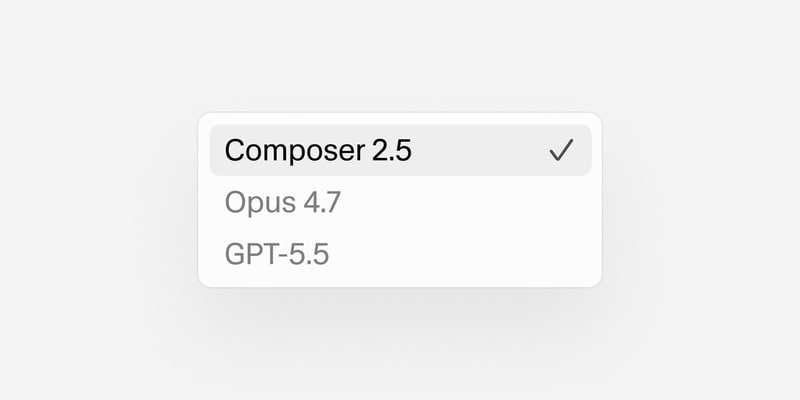
Cursor released Composer 2.5, a third-generation coding model built on the Kimi K2.5 foundation model, featuring expanded training on synthetic coding tasks and updated pricing tiers aimed at AI-assisted software development. The model was launched as a hosted service with temporarily increased usage limits and follows Cursor’s decision to explicitly disclose its underlying model architecture after community feedback around previous releases.
Composer 2.5 is available in standard and higher-speed variants with different token pricing structures and throughput options. Cursor reported benchmark results showing comparable coding performance to higher-priced alternatives at a lower per-task cost, although independent evaluation will be needed to validate those claims. The company also emphasized the importance of reviewing and validating generated code before deployment.
For developers, Composer 2.5 expands access to lower-cost coding assistance while providing more flexibility for production workloads. The launch reflects intensifying competition among AI coding platforms as vendors compete on pricing, performance and deployment practicality for enterprise and developer teams.
Image Credit: Cursor
Key Themes Behind This Trend
- Lower-cost Coding Models
- The emergence of competitively priced coding models creates scope for automating routine implementation and code-review tasks previously reserved for junior engineers.
- Model Transparency and Disclosure
- Explicit disclosure of underlying model architectures enables independent validation and the growth of third-party audit, benchmarking and compliance services tailored to coding AI.
- Hosted High-throughput Coding Services
- Temporarily increased usage limits and high-throughput variants point toward integrated, low-latency code generation services that can be embedded into IDEs and real-time developer workflows.
Where This Applies
- Software Development Platforms
- Platforms can consolidate multiple coding models and dynamic pricing options to offer intelligent model routing, cost-optimized coding assistants and usage-based feature tiers.
- Enterprise IT Procurement
- New token-based pricing and tiered throughput introduce opportunities for procurement strategies focused on per-task cost optimization and vendor selection based on validated performance metrics.
- Devops and CI/CD Tooling
- AI-assisted code generation shifts the landscape for pipeline tooling toward automated test generation, pre-deployment code validation and seamless integration of model outputs into CI/CD workflows.