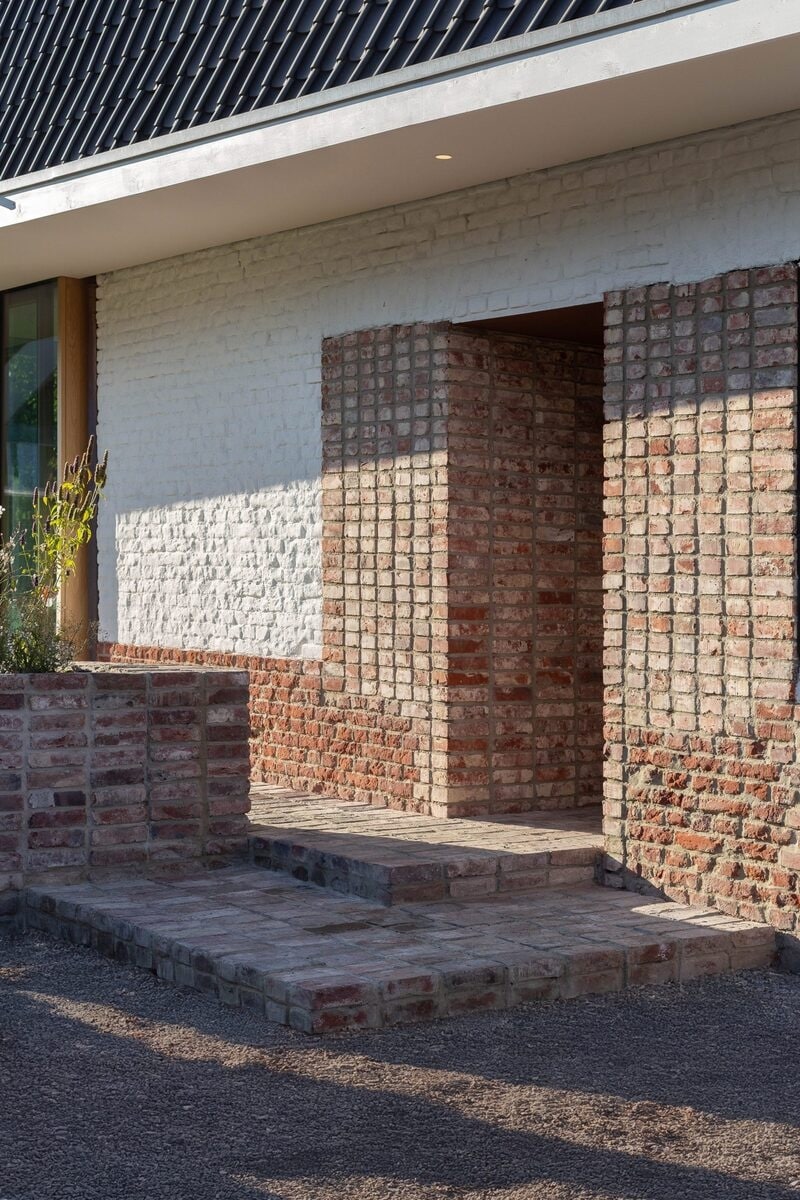
Brick to Light is a renovation of a former barracks house in Münster, Germany, completed by local studio Andreas Schüring Architekten. Originally part of a military complex built in 1913, the house was retained when the wider site was redeveloped into the car-free Gartensiedlung Weißenburg neighbourhood. The project treats renovation as a seamless continuation, preserving the building’s brick structure while introducing timber, steel, and glass. The layout was reorganised across four levels, including a basement and a new attic studio, after most internal walls were removed to create a more open plan.
A full-height stair set against a white-painted brick wall connects all floors, allowing daylight from roof skylights to filter through the interior. At ground level, a carved entrance niche leads into an open living, dining, and kitchen space that opens westward to the garden through full-height glazing. Above, bedrooms are positioned behind curtains and built-in timber storage, while the extended mansard roof forms a fully glazed attic studio designed as a glass lantern.
Image Credit: Andreas Schüring Architekten
What's Driving This Trend
- Sustainable Roof Conversions
- Historic roof conversions integrate sustainable materials like timber and glass to reduce environmental footprint while preserving heritage.
- Open-plan Living Spaces
- Renovations emphasize open-plan living, transforming traditional interiors into modern, light-filled spaces beneficial for flexible living arrangements.
- Car-free Neighborhood Development
- The development of car-free neighborhoods showcases a shift towards urban spaces prioritizing pedestrian-friendly, environmentally-conscious living areas.
Who This Affects Most
- Architectural Renovation
- The architectural renovation industry is innovating with a focus on blending historical preservation with modern sustainability practices.
- Urban Planning and Development
- Urban planning is increasingly exploring car-free models, creating environments that prioritize sustainability and community-driven design.
- Sustainable Construction Materials
- The use of timber and glass highlights the construction industry's shift towards materials that minimize environmental impact while maintaining design integrity.