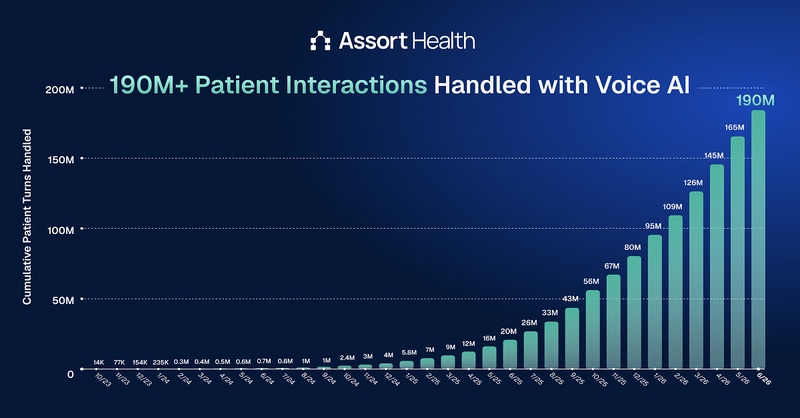
Assort Health, a platform that deploys artificial intelligence agents to manage the patient journey, has announced a $120 million Series C funding round led by Menlo Ventures, valuing the company at $1.2 billion and bringing total raised capital to over $222 million. This backing will help the company on its mission to become the standard for healthcare organizations aiming to transform administrative workflows with AI.
Assort Health's platform has evolved from an initial focus on voice AI for scheduling specialty appointments into a comprehensive system that now handles scheduling, intake forms, referrals, document processing, medication refills, real-time eligibility checks, lab requests, and payments. These capabilities are informed by more than 190 million patient interactions and a proprietary AI model called Synapse that learns specialty workflow patterns across deployments.
Image Credit: Assort Health
Part of the cluster
Ambient Care
Digital tools improve health by guiding patients before, during and between visits
Explore the cluster



What Makes This Trend Stand Out
- AI Patient Navigation
- Intelligent agents that coordinate scheduling, intake, referrals, and follow-up services create new space for healthcare platforms that reduce administrative friction across the full patient journey.
- Specialty Workflow Automation
- Specialty-specific AI models trained on large volumes of patient interactions enable more precise automation for complex care environments with fragmented operational requirements.
- Voice-enabled Care Access
- Conversational interfaces for appointment booking, eligibility checks, and medication requests signal growing potential for always-available digital front doors in healthcare delivery.
Sectors Adopting This
- Healthcare Technology
- AI-native infrastructure for administrative workflows expands the market for platforms that combine patient engagement, document processing, and revenue-cycle support in one system.
- Health Insurance
- Real-time eligibility verification and automated referral handling introduce opportunities for payer-provider connectivity that lowers delays and improves coverage transparency.
- Medical Administration
- Back-office functions such as forms processing, lab requests, payments, and scheduling are being reshaped by agentic systems that reduce manual workload and standardize operations.