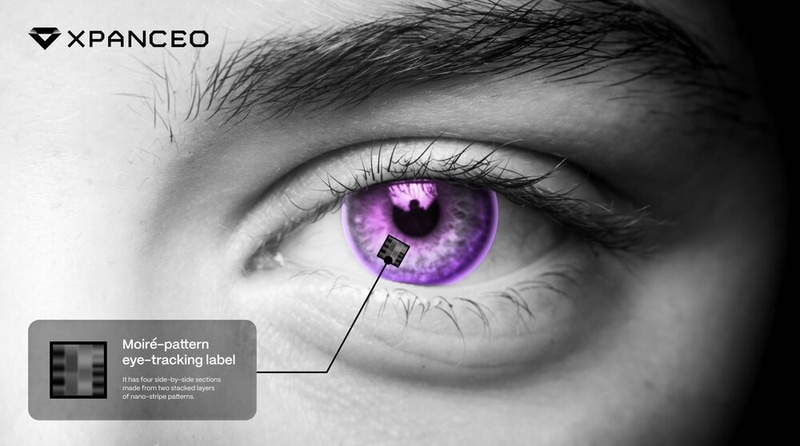
XPANCEO is advancing wearable technology with contact lenses that enable passive eye tracking using standard cameras. Unlike conventional systems that rely on infrared illumination and power-intensive sensors, these lenses use microscopic optical patterns to generate moiré effects that shift with eye movement. This allows precise gaze detection without batteries or embedded electronics, reducing hardware complexity while maintaining high accuracy.
This approach expands the potential for seamless interaction across devices, including smartphones, vehicles, and head-mounted systems, where built-in cameras can interpret eye movement in real time. For healthcare, the system introduces new possibilities for monitoring subtle eye behaviors linked to neurological conditions, supporting earlier detection and ongoing assessment. In industrial and transportation settings, it could enhance safety by identifying fatigue or cognitive impairment. As a result, brands and manufacturers may explore more scalable, low-power eye-tracking solutions that integrate effortlessly into existing ecosystems.
Image Credit: XPANCEO
What Makes This Trend Stand Out
- Passive Camera-readable Biometrics
- Low-power optical patterns on contact lenses enable reliable eye-tracking via standard cameras, reducing reliance on dedicated sensors and opening pathways for ubiquitous biometric input.
- Moiré-based Motion Sensing
- Moiré-effect microstructures translate subtle ocular rotations into trackable visual signatures, offering precise motion detection without onboard electronics.
- Powerless Wearable Interaction
- Battery-free wearables that rely on external imaging for state reporting create lightweight interaction modalities compatible with existing camera-equipped ecosystems.
Sectors Adopting This
- Consumer Electronics
- Integration with smartphones, AR glasses, and cameras could allow manufacturers to offer low-cost, always-on gaze interfaces that simplify hands-free control and accessibility features.
- Healthcare Diagnostics
- Objective, camera-based monitoring of micro eye movements presents potential for earlier detection and longitudinal assessment of neurological and ophthalmic conditions.
- Automotive & Transportation
- In-vehicle camera systems paired with camera-readable lenses can provide non-invasive fatigue and attention monitoring to augment driver safety frameworks.