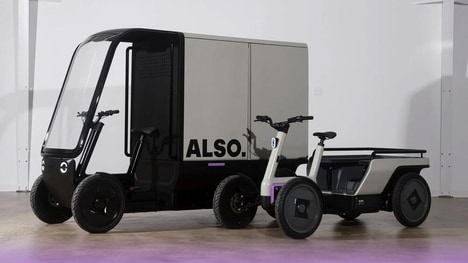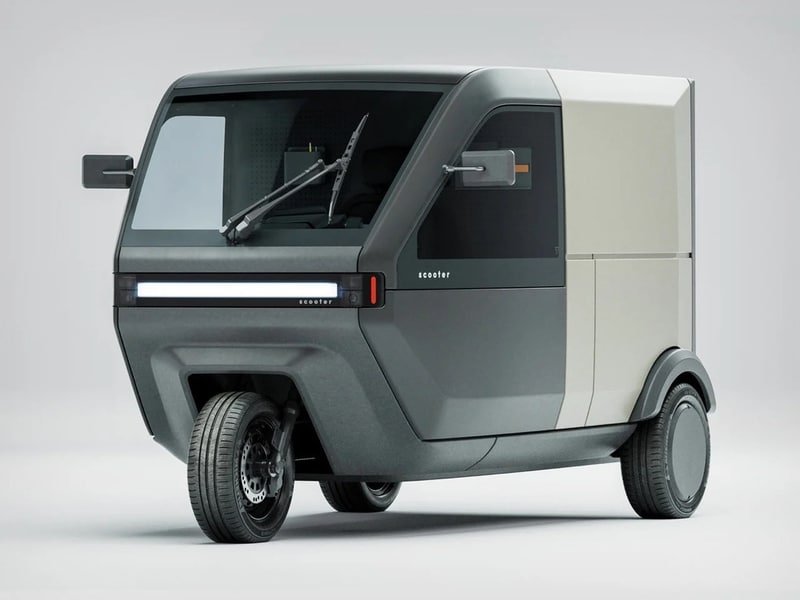
Voyager P2 electric trike is a three-wheeled delivery vehicle designed around dense urban movement rather than highway performance. The Voyager P2 electric trike features a single front wheel and dual rear axle, allowing it to combine the maneuverability of a two-wheeler with the stability needed for cargo transport. Its narrow width enables lane filtering and access to tight streets where conventional vans struggle, while the enclosed cabin protects the rider from weather conditions during daily use. The design prioritizes real-world delivery patterns, balancing size, range, and usability instead of optimizing for a single metric.
The rear axle provides traction and stability when stationary, while the front wheel uses standard tire sizing to improve braking and performance on uneven roads. Cargo capacity is integrated into the structure, supporting multiple use cases including commuting, errands, and delivery work. The form adopts angular surfaces inspired by the Tesla Cybertruck, giving the vehicle a more substantial presence within mixed traffic
Image Credit: Jeroen Claus, Fabian Breës
Why This Trend Is Growing
- Narrow-footprint Urban Mobility
- A focus on ultra-narrow vehicle footprints enables access to constrained street networks and dense urban corridors that render conventional vans inefficient.
- Enclosed Micro-logistics
- Weather-protected cabins on small delivery vehicles significantly extend usable operating days and broaden route viability across seasons.
- Integrated Cargo-structure Vehicles
- Embedding cargo capacity into the vehicle architecture reduces wasted volume and creates opportunities for modular payloads tailored to mixed-use urban trips.
Industries Being Reshaped
- Last-mile Delivery
- Delivery operators confronting high stop density and restricted access can be enabled by vehicles that trade speed for maneuverability and operational uptime.
- Urban Mobility Services
- Shared mobility fleets and micromobility providers could shift service offerings toward weather-protected, cargo-capable units that change trip composition and revenue models.
- Light Commercial Vehicle Manufacturing
- Manufacturers focusing on compact, enclosed three-wheel platforms may reshape production lines and supply chains with chassis-integrated cargo systems and low-volume specialty components.