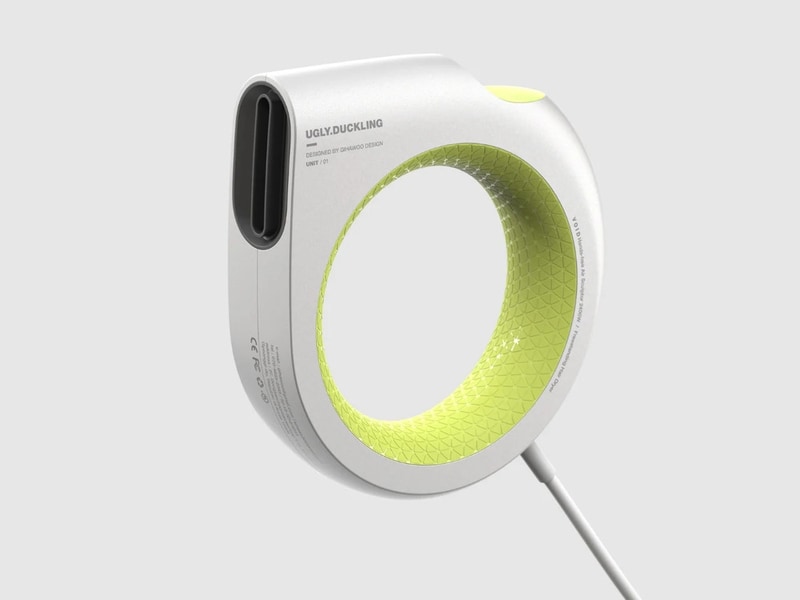
The VOID hair dryer concept by Seoul-based designer Giha Woo reimagines the form of a conventional blow dryer by removing the handle entirely. The VOID hair dryer replaces the familiar pistol-grip structure with a hollow torus-shaped ring that can be held from multiple positions or placed into a freestanding cradle for hands-free use. The circular body leaves an open center where airflow passes through, creating a geometric object that can be angled freely rather than fixed to a single grip orientation.
The ring structure allows users to grip the dryer at different points or position it in its stand while directing airflow toward the head. A compact motor and directional outlet system are integrated within the circular body, while textured surfaces inside the ring provide grip when holding the device.
Image Credit: Giha Woo
What's Driving This Trend
- Handle-free Ergonomic Design
- A departure from traditional grips toward body-contoured forms that enable ambidextrous handling and cradle placement, revealing new product form factors that redefine user interaction.
- Modular Hands-free Appliances
- Products that integrate cradles and self-supporting geometries to allow intermittent hands-free operation are creating opportunities for rethinking appliance workflows and user multitasking.
- Spatially-oriented Airflow Systems
- Air delivery architectures that route output through hollow or ringed structures permit targeted, adjustable airflow and compact motor placements that could transform performance-to-size ratios.
Who This Affects Most
- Personal Care Devices
- Devices for hair and grooming are being reconceived with unconventional geometries and integrated stands, enabling novel user experiences and differentiation in a saturated market.
- Home Appliance Manufacturing
- Manufacturers are facing pressure to incorporate compact motors and multifunctional housings into aesthetically driven products, prompting shifts in production processes and component sourcing.
- Industrial Design Services
- Design consultancies that can marry ergonomic research with engineering constraints are increasingly positioned to create disruptive form factors that challenge legacy product conventions.