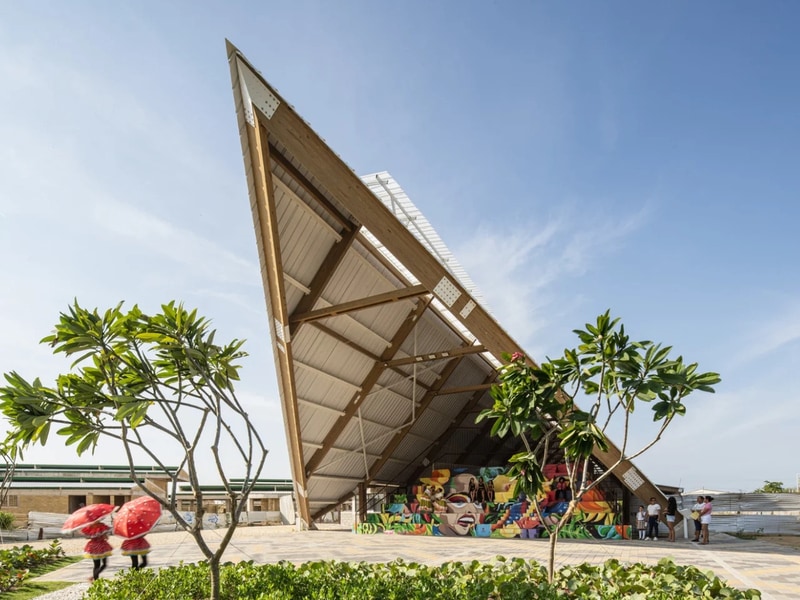
The Villas de San Pablo Cultural Center was completed in 2025 by ETH Zurich architects Hubert Klumpner and Diego Ceresuela Wiesmann with Colombian architect Alejandro Restrepo Montoya as a community-focused facility in Barranquilla, Colombia. The 2,200-square-meter building serves a social housing neighborhood largely inhabited by displaced families, migrants, and low-income residents. Developed through a participatory design process involving local residents, community leaders, artists, universities, and public institutions, the project centers on a lightweight canopy that provides shade and weather protection while responding to the city's hot climate and seasonal rainfall.
The cultural center forms part of a broader 20-Minute City strategy that places essential services within walking distance of surrounding homes. The facility combines spaces for cultural programming, maker activities, digital resources, and community events to support education, creativity, and local economic development. Construction began after years of planning between 2018 and 2025 with support from the Swiss Secretariat for Economic Affairs, Fundación Santo Domingo, and the Municipality of Barranquilla.
Image Credit: Alejandro Arango Escobar
Why This Trend Is Growing
- Participatory Civic Design
- Resident-led planning models are reshaping public infrastructure by embedding local needs, cultural identity, and social trust into community facilities.
- 20-minute Neighborhoods
- Walkable access to cultural, educational, and digital resources creates new models for equitable urban development in underserved areas.
- Climate-responsive Canopies
- Lightweight shaded structures offer scalable architectural solutions for hot, rainy cities facing rising climate adaptation demands.
Industries Being Reshaped
- Urban Planning
- Inclusive neighborhood strategies are expanding the role of planning firms in designing mixed-use civic hubs near housing communities.
- Architecture
- Community-centered facilities introduce opportunities for climate-sensitive, low-cost building systems that serve both social and environmental needs.
- Social Infrastructure
- Multipurpose cultural centers are becoming platforms for education, entrepreneurship, and public services in communities with limited institutional access.