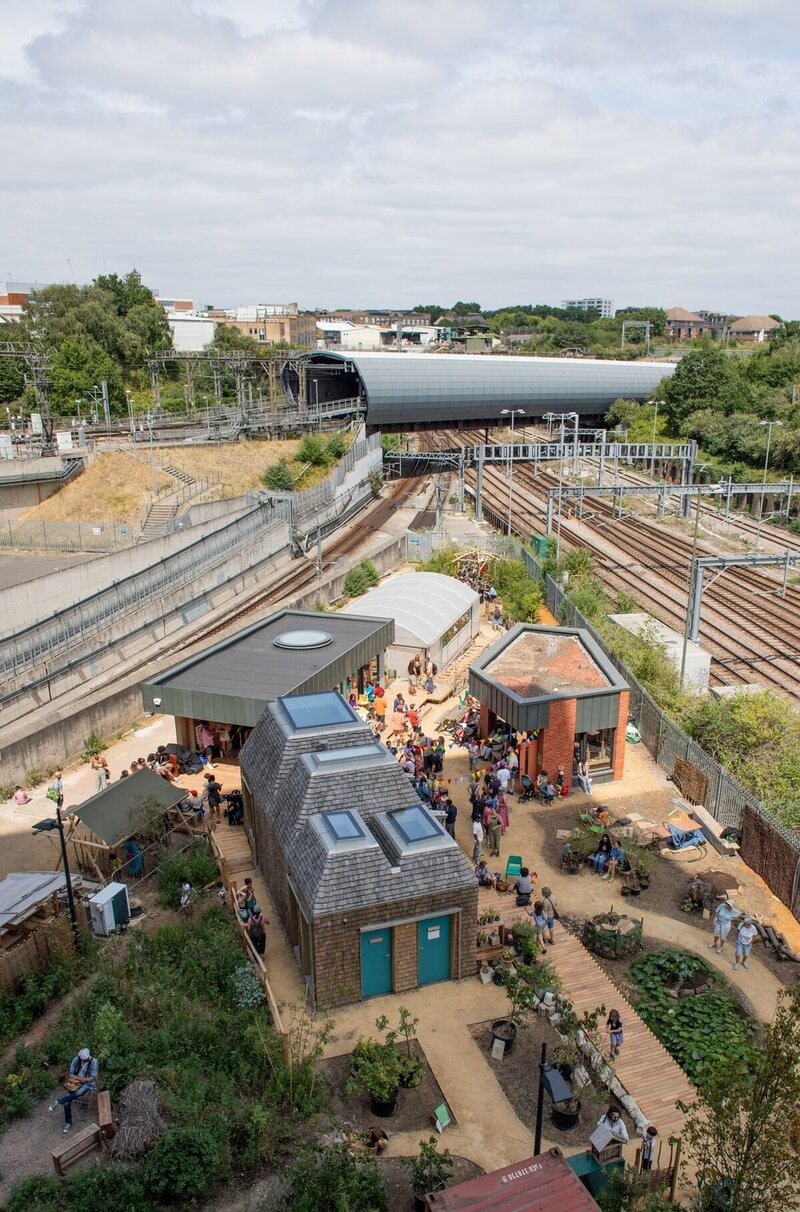
The Triangle Site is a community garden in King's Cross designed by Jan Kattein Architects as a permanent home for educational charity Global Generation. Constructed over two years through a community-led building programme, the project involved on-site architects, builders, trainees, and more than 3,000 volunteers. Three standalone buildings containing a classroom, office, and community kitchen are arranged around a central courtyard, while the surrounding landscape incorporates an edible forest, rubble garden, pond, and polytunnel.
The buildings were constructed primarily from bio-based materials using techniques intended to support hands-on participation throughout the build. The community kitchen is clad with 12,000 handmade wooden shakes and contains storage spaces and separately accessed toilets illuminated by deep skylights. A classroom is organized around a cob wall formed from locally sourced waste earth and finished with lime render, with daylight entering through a circular skylight, clerestory glazing, and full-height windows.
Image Credit: Jan Kattein Architects
What's Driving This Trend
- Community-led Construction
- Participatory building models reveal potential for developments that combine local skills training, civic ownership, and lower-cost project delivery.
- Bio-based Learning Spaces
- Natural materials such as timber, cob, and lime create openings for healthier educational environments with reduced embodied carbon.
- Edible Urban Campuses
- Integrated food-growing landscapes point to new models for combining education, ecology, and community programming in dense city sites.
Who This Affects Most
- Architecture
- Permanent community-built structures suggest expanded roles for architects as facilitators of collaborative design and hands-on construction.
- Urban Agriculture
- Food-producing gardens embedded in civic spaces highlight opportunities for local resilience, environmental education, and social infrastructure.
- Education
- Outdoor classrooms and garden-based facilities signal demand for experiential learning settings that connect students with sustainability practices.