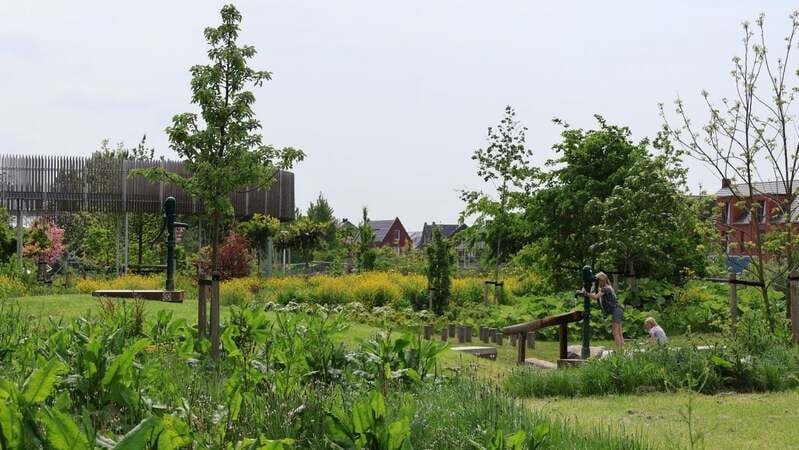
The Rijnvliet project by Felixx and De Zwarte Hond creates a community rooted in local food production by planning an entire district where edible landscapes are embedded into public spaces, allotments, and shared gardens. The design weaves fruit trees, vegetable beds, and foraging zones into streets, squares, and courtyards, transforming conventional urban land into productive terrain that supports social engagement and biodiversity. The housing blocks are arranged around courtyards that double as communal growing areas, and pathways extend through green belts to connect neighbors via gardening and gathering.
The strategy focuses on experience as much as infrastructure by encouraging residents to participate in planting, harvesting, and sharing produce within their daily routines. The layout downplays private gardens in favor of collective green space and reinforces the idea that food can be a framework for community building.
Image Credit: Felixx, Jeroen Musch and Hedayatullah Amid
What Makes This Trend Stand Out
- Edible Public Spaces
- The integration of food-producing plants in urban designs transforms ordinary public spaces into multifunctional environments that encourage community interaction and sustainable living.
- Community Engagement in Food Production
- By actively involving residents in the planting and harvesting process, urban projects foster a sense of ownership and collaboration among community members.
- Biodiversity-enhancing Urban Design
- Incorporating diverse plant species within city layouts supports ecological balance and introduces natural habitats into urban settings.
Sectors Adopting This
- Sustainable Urban Planning
- This industry explores how to incorporate environmental sustainability into community frameworks by integrating food production into urban architecture.
- Community-based Agriculture
- Focusing on locally-produced food, this industry sees neighborhoods as potential agricultural hubs, supporting local food networks and reducing carbon footprints.
- Green Infrastructure Development
- Developing infrastructural elements that prioritize ecological functions and promote environmental resilience is a growing focus within this industry.