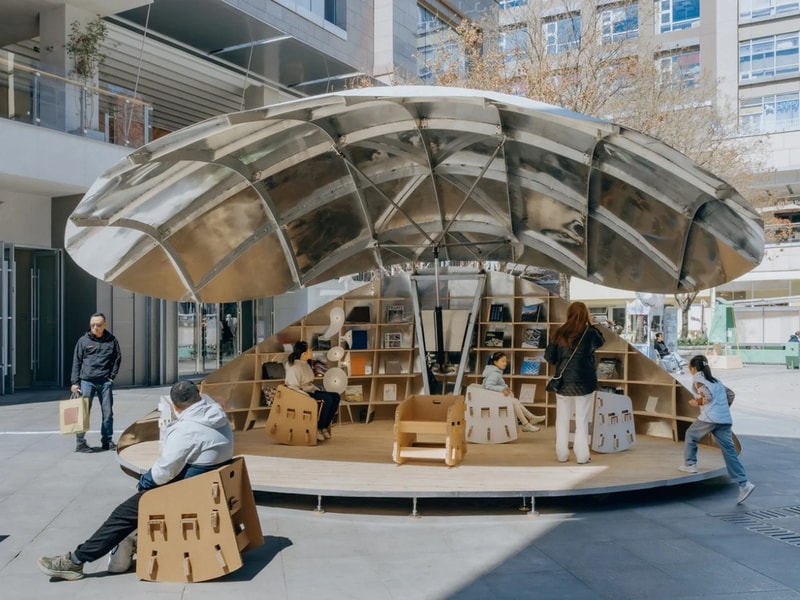
The Shell Book Pavilion by LUO Studio is a 43-square-meter public reading structure located in Xiangyun Town, Beijing. The Shell Book Pavilion by LUO Studio features a clamshell form that physically opens and closes through a vertical lifting system, shifting between an open canopy and a more enclosed reading space. The aluminum shell structure has no fixed front or back, allowing access from all directions within the plaza.
The pavilion is designed as a small-scale community library, with movable seating extending activity beyond its footprint. The opening mechanism allows the structure to adjust throughout the day, altering light, enclosure, and spatial experience. Positioned within a commercial district, the project functions as a flexible public space for reading and gathering. Its compact scale emphasizes adaptability, using a simple mechanical system to transform how users engage with the environment.
Image Credit: LUO Studio
Key Themes Behind This Trend
- Adaptive Public Architecture
- Adaptive public architecture that changes form and openness throughout the day creates opportunities for dynamic civic assets that respond to varying programmatic and environmental needs.
- Kinetic Pavilion Design
- Kinetic pavilion design using simple mechanical systems introduces possibilities for movable structures that redefine temporality and multiuse functionality in public plazas.
- Micro-scale Community Libraries
- Micro-scale community libraries embedded in commercial districts suggest new models for hyper-local knowledge hubs that blend retail foot traffic with cultural programming.
Where This Applies
- Urban Planning
- Urban planning stands to incorporate transformable installations as tactical interventions that shift circulation, programming, and public realm activation at fine-grained scales.
- Architecture and Engineering
- Architecture and engineering could leverage lightweight materials and vertical-lift mechanisms to develop cost-effective, reconfigurable structures that expand design flexibility.
- Furniture and Modular Seating
- Furniture and modular seating companies may explore integrated, movable furniture systems that extend activity zones beyond a structure's footprint and adapt to changing spatial conditions.