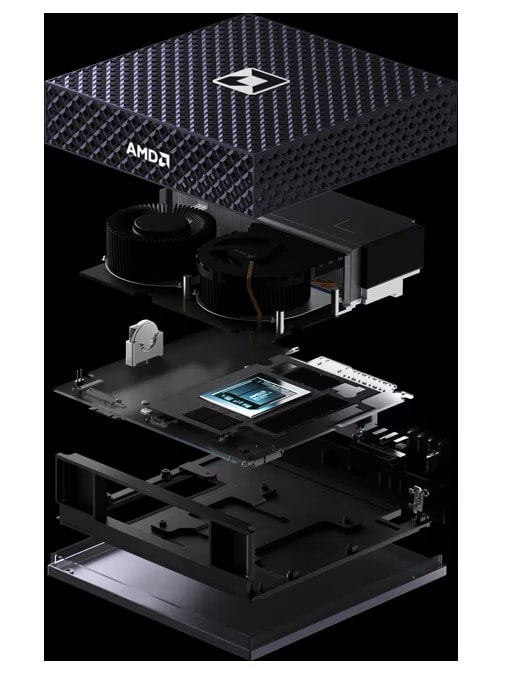
AMD introduced the Ryzen AI Halo PC, a workstation designed for local AI development and inference, featuring 128GB of unified memory and a custom APU with integrated graphics and AI accelerators. The system is available immediately and targets developers seeking on-premises AI computing without requiring a separate discrete GPU.
The Halo architecture enables the CPU, graphics and AI engines to share a single memory pool, reducing data movement and supporting models with up to roughly 70 billion parameters, according to AMD. Priced at $3,999, the workstation is positioned as a lower-cost alternative to competing AI development systems while emphasizing high memory capacity and local execution.
For developers and researchers, Ryzen AI Halo enables lower-latency, privacy-conscious AI workflows by reducing cloud dependence, reflecting the growing demand for accessible on-premises infrastructure for large language model development and inference.
Image Credit: AMD
What Makes This Trend Stand Out
- Local AI Workstations
- High-memory desktop systems are reshaping AI development by bringing large-model inference closer to users with lower latency, stronger privacy and reduced cloud dependency.
- Unified Memory Computing
- Shared memory architectures create new performance and cost efficiencies by allowing CPUs, GPUs and AI accelerators to access large models without costly data movement.
- Affordable Enterprise AI Hardware
- Lower-priced AI development machines expand access to advanced model experimentation for smaller teams that previously relied on expensive cloud infrastructure or specialized GPU servers.
Sectors Adopting This
- Computer Hardware
- Workstations with integrated AI acceleration open competitive space for manufacturers to deliver compact, high-capacity systems optimized for local inference and development.
- Artificial Intelligence
- On-premises AI infrastructure supports privacy-sensitive model training, testing and deployment for organizations seeking greater control over data, latency and operating costs.
- Software Development
- Developer workflows gain new flexibility as local large language model environments enable faster prototyping, offline experimentation and customized AI application creation.