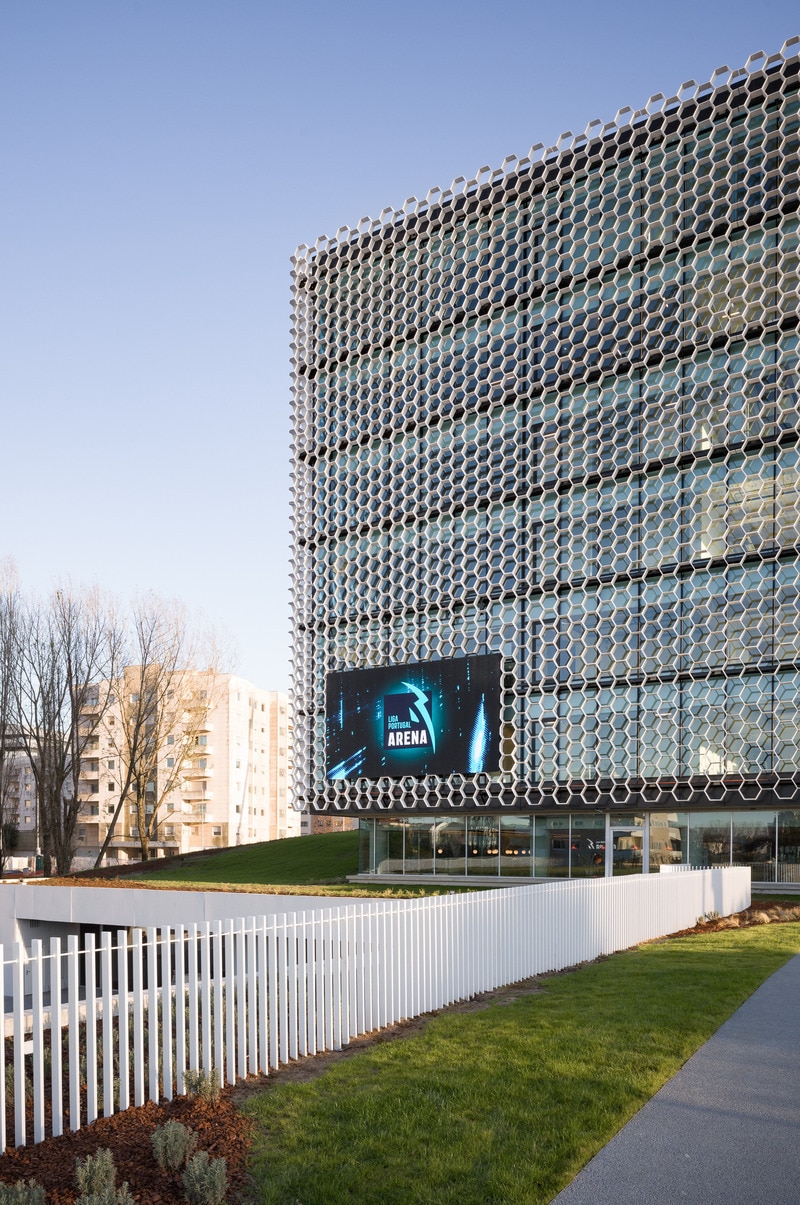
OODA's Liga HQ in Porto — a facility that houses the Portuguese Football League's headquarters — represents a sophisticated architectural intervention that reimagines the relationship between institutional sports facilities and urban public space. The multifunctional complex transcends conventional administrative buildings by integrating diverse programs, including offices, a museum, an auditorium, a sports pavilion, and expansive gardens within a cohesive design inspired by football's elemental simplicity.
The Liga HQ's striking visual identity emerges from its two primary components - an expansive green roof extending the adjacent riverside park's landscape, and a luminous cube-shaped tower clad in hexagonal white panels that subtly reference football iconography through their ball-like texture. This dual composition achieves both symbolic resonance and practical urban connectivity, with the public square at its base serving as both a civic gathering space and a transitional zone between city and institution.
Image Credit: Pedro Cardigo
Why This Trend Is Growing
- Urban-integrated Sports Complexes
- The concept of sporting facilities blending into urban landscapes challenges traditional boundaries and enhances community interaction.
- Multipurpose Sports Architecture
- Facilities combining administrative, cultural, and recreational functions offer new pathways for maximizing space and engagement in sports environments.
- Football-inspired Design Elements
- Using symbolic elements from football in architectural design delivers a unique identity and enhances thematic cohesion in sports venues.
Industries Being Reshaped
- Sports Architecture
- Architectural designs that reflect sporting motifs unlock novel potentials for merging aesthetic appeal with functionality in sports-related infrastructures.
- Urban Planning
- Promoting the integration of sports facilities into urban settings creates opportunities for developing dynamic public spaces that foster community interaction.
- Landscape Architecture
- Innovative design approaches that extend natural landscapes into urban sports complexes open up new possibilities for sustainable and attractive city planning.