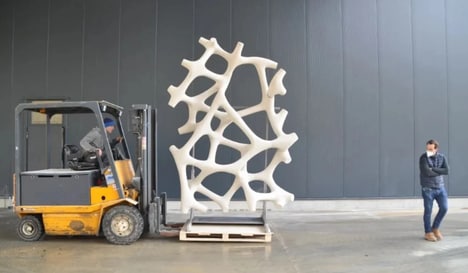

Orbital Matter used its ‘Replicator 2’ satellite to manufacture a beam in orbit, giving spacecraft builders a way to create structures after launch rather than packing them inside a rocket fairing. The German startup formed a half-meter beam from a plastic material for missions that need solar arrays.
‘Replicator 2’ launched in summer 2026 on a SpaceX rideshare with four printers. Each printer extrudes resin and cures it with ultraviolet light. Two printers were intended to extend a flexible solar array. One experienced an anomaly, but the printed boom still deployed the array. Orbital Matter built the demonstration with the European Space Agency and Thales Alenia.
The half-meter beam moves 3D printing beyond station tests to a free-flying satellite, which matters for builders seeking more power and heat rejection. A mission planned for 2028 could turn the concept into a business-to-business option for satellite makers considering larger panels or antennas.
Image Credit: Orbital Matter
Key Themes Behind This Trend
- In-orbit Manufacturing
- Spacecraft components produced after launch reduce fairing constraints and open new possibilities for larger arrays, antennas, and modular orbital infrastructure.
- Deployable Space Structures
- Printed booms and flexible supports create pathways for satellites with expanded power generation and thermal-management capacity without larger launch vehicles.
- Free-flying 3D Printing
- Autonomous orbital printers shift additive manufacturing from controlled station environments to commercial satellite platforms, enabling scalable production services in space.
Where This Applies
- Satellite Manufacturing
- Bus and payload designers gain access to post-launch structural fabrication that supports bigger panels, sensors, and antennas within compact launch packages.
- Space Energy Systems
- Solar-array providers can benefit from printed deployment supports that increase surface area and power availability for high-demand orbital missions.
- Aerospace Materials
- UV-cured resins and space-rated polymers become strategic materials for lightweight structures formed directly in orbit under vacuum and radiation conditions.