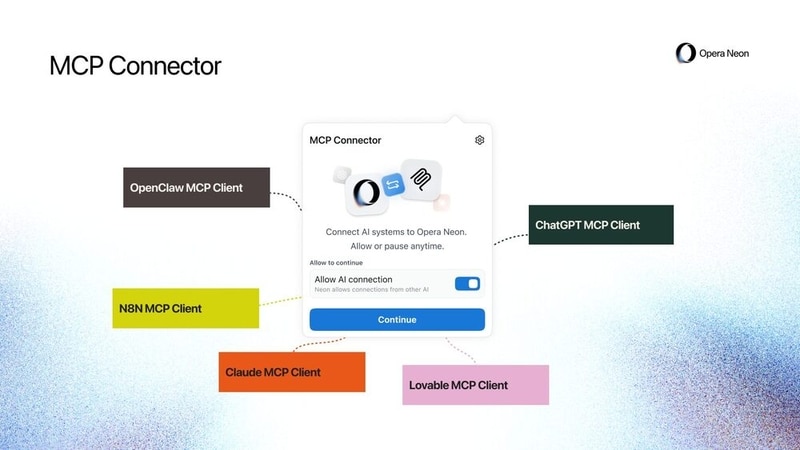
Opera’s MCP Connector marks a shift in how AI interacts with digital environments. Rather than operating in separate interfaces, AI tools can now plug directly into a user’s browser session, accessing live tabs, content, and authenticated states. This removes the need to manually transfer context between tools, allowing AI systems to act within the same environment where work is already taking place. The browser becomes more than a viewing layer—it becomes a space where actions are executed.
For companies, this creates opportunities to embed AI into existing workflows without requiring users to change platforms. It supports faster task completion, deeper automation, and more seamless user experiences. At the same time, it positions browsers as central control points in the AI ecosystem, increasing competition among platforms while raising new questions around data access, privacy, and system reliability.
Image Credit: Opera
Key Themes Behind This Trend
- In-browser Autonomous Agents
- AI agents embedded in browsers enable continuous, context-aware task execution across live tabs and authenticated sessions, redefining where and how digital work is performed.
- Contextual State Integration
- By granting AI access to active content and session states, tools can provide deeper personalization and reduce friction from manual data transfers between applications.
- Browser as Execution Layer
- The browser evolving into an action-capable platform centralizes control of workflows and creates a unified surface for automation and orchestration of web-based tools.
Where This Applies
- Enterprise Productivity Software
- Seamless in-browser AI interactions can transform collaboration suites and task managers by embedding smart automation directly into users' existing workflows and document contexts.
- Cybersecurity and Privacy
- The expansion of AI access to authenticated sessions and live content introduces new vectors for data exposure and creates demand for novel controls around consent, auditing, and secure data handling.
- Digital Advertising and Personalization
- Real-time AI understanding of browsing context and user intent could enable highly adaptive ad experiences and content recommendations tied to immediate user activity.