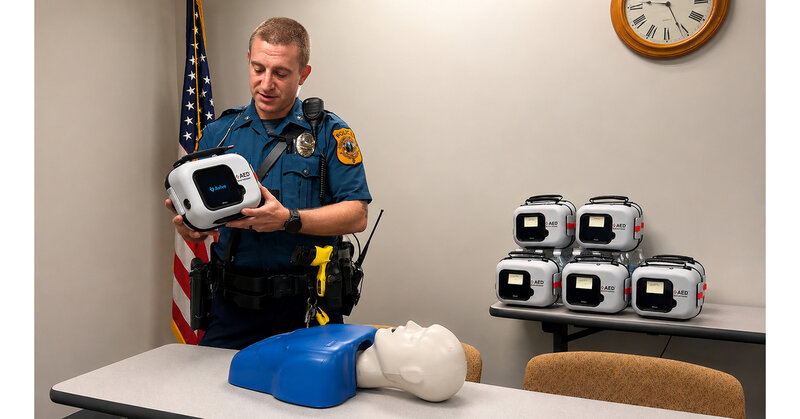
Avive Solutions expanded public-access emergency care in Lower Salford Township, Pennsylvania, with 16 ‘Avive Connect’ automated external defibrillators (AEDs) replacing an older fleet that had become expensive to maintain and hard to track. The rollout puts AEDs in police vehicles, municipal buildings and parks so officers and residents can reach one sooner during a cardiac emergency.
Six devices stay in patrol cars, and others sit in public cabinets at township sites including the Community Center and Charles Reed Park. ‘REALConnect’ shows staff each unit’s location and status, while a rechargeable battery and one pad set for adults and children reduce upkeep.
Avive Solutions shows how remote tracking and rechargeable hardware make a spread-out AED network easier for municipal buyers to manage by reducing manual checks, while public placement beyond police cars widens access by moving lifesaving gear into everyday spaces.
Image Credit: Avive Solutions, Inc.
What's Driving This Trend
- Connected Public Safety Devices
- Networked AEDs with remote status monitoring reveal opportunities for municipalities to reduce equipment downtime and improve emergency readiness across distributed public assets.
- Rechargeable Emergency Hardware
- Rechargeable batteries and simplified pad systems signal a shift toward lower-maintenance lifesaving devices that ease long-term ownership costs for public agencies.
- Everyday Space Lifesaving Access
- Placing defibrillators in parks, community centers and municipal buildings expands the role of shared civic spaces as accessible emergency care points.
Who This Affects Most
- Emergency Medical Services
- Remote-managed AED networks create new potential for faster cardiac response coordination between first responders, municipal staff and bystanders.
- Smart City Technology
- Real-time device tracking and location visibility position public safety equipment as part of broader connected infrastructure strategies.
- Municipal Government
- Modernized AED fleets illustrate how local governments can adopt subscription-like, data-enabled equipment models that simplify compliance, maintenance and budgeting.