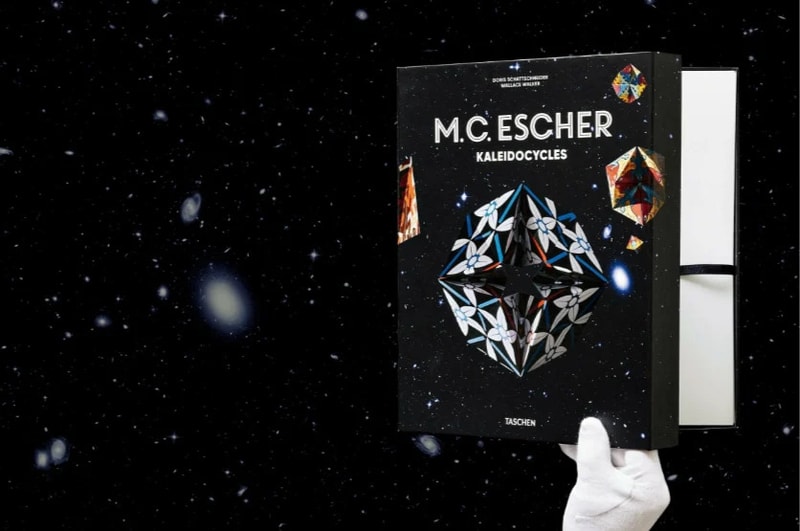
M.C. Escher Kaleidocycles are paper-based geometric structures that convert two-dimensional patterns into continuous three-dimensional motion. The designs are built from connected segments arranged in a loop, allowing the form to rotate endlessly while revealing different surfaces. As the structure turns, patterns shift across faces in a seamless sequence, creating the illusion of transformation without a fixed beginning or end. The models are based on Escher’s original explorations of symmetry and spatial logic.
Each kaleidocycle functions as a flexible polyhedral form, typically composed of linked tetrahedral units that act as hinges during rotation. This construction enables the object to twist continuously around its axis while maintaining a closed loop. The project translates Escher’s mathematical approach into a physical format. Users can engage directly with movement, structure, and pattern through hands-on interaction rather than static viewing.
Image Credit: TASCHEN
What Makes This Trend Stand Out
- Transformative Rotational Interfaces
- Rotating polyhedral mechanisms offer interfaces that shift functional surfaces continuously, enabling devices with stateful behaviors embedded in their physical motion.
- Tactile Algorithmic Design
- Paper-based implementations of mathematical symmetry reveal low-cost methods for encoding computational rules into foldable, user-manipulable objects that alter form and function.
- Continuous Pattern Dynamics
- Seamless sequence displays created by linked facets introduce possibilities for products whose visual or informational content evolves fluidly without electronic screens.
Sectors Adopting This
- Packaging and Branding
- Brands can exploit rotating structures to create packaging that presents changing graphics and messaging as the container is manipulated, transforming unboxing into an evolving narrative.
- Educational Technology
- Hands-on kaleidocycle models provide tangible platforms for teaching geometry and algorithms, offering learners physical demonstrations of abstract mathematical concepts.
- Wearable Textile Design
- Modular hingeable motifs inspire garments and accessories that reconfigure appearance and ventilation through mechanical rotation rather than electronic components.