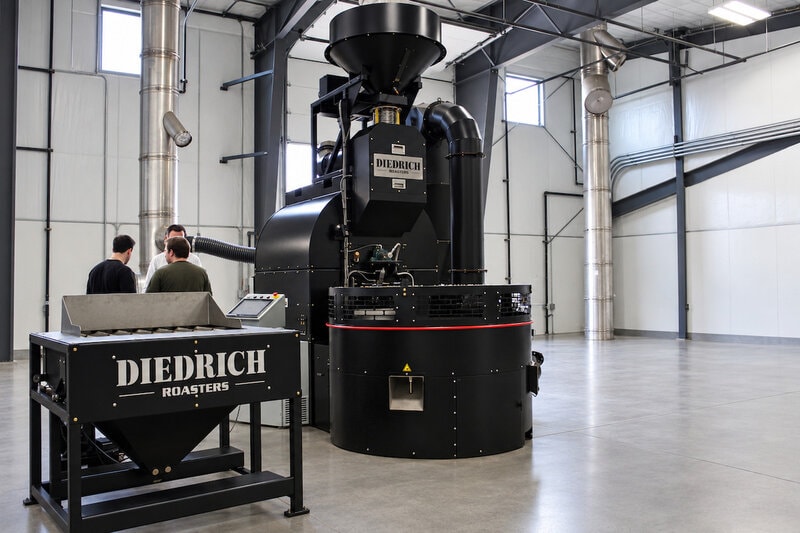
Diedrich Roasters is moving its larger gas-fired machines away from infrared burners with the DR-140, a coffee roaster for midsize and larger commercial roasters that replaces the CR-140 with tighter heat, airflow and drum-speed control. It can produce up to 560 kilograms an hour, helping bigger plants hold steadier roast profiles as output climbs.
Redesigned insulated drums and revised airflow routing keep heat moving more evenly through the beans, while water quenching supports controlled and emergency cooling. The platform also works with Cropster and Artisan for roast logging, with service and training through Diedrich's Idaho and Schaumburg, Illinois facilities.
In-house control software and direct service access turn the roaster into a tighter operating package for commercial buyers, reducing the split between programming, maintenance and training. Completing the shift from infrared burners gives Diedrich a clearer gas-fired lineup, which can simplify replacement decisions for companies still running CR and IR machines.
Image Credit: Diedrich
What Makes This Trend Stand Out
- Precision Roast Automation
- Advanced control over heat, airflow and drum speed creates room for commercial roasters to standardize flavor outcomes while scaling production capacity.
- Integrated Roaster Software
- Compatibility with roast logging platforms and in-house controls signals growing potential for data-rich production systems that connect profiling, training and maintenance.
- High-capacity Gas Roasting
- Larger gas-fired platforms with improved thermal consistency introduce new possibilities for legacy equipment replacement in midsize and industrial roasting operations.
Sectors Adopting This
- Commercial Coffee Equipment
- Equipment makers can differentiate through tighter process control, simplified product lineups and service-backed platforms for high-volume roasting facilities.
- Specialty Coffee Production
- Roasters focused on consistency at scale benefit from technologies that preserve nuanced profiles across larger batches and faster throughput.
- Food Manufacturing Technology
- Industrial food processors are seeing value in machinery that combines production performance, software integration and operational support into unified systems.