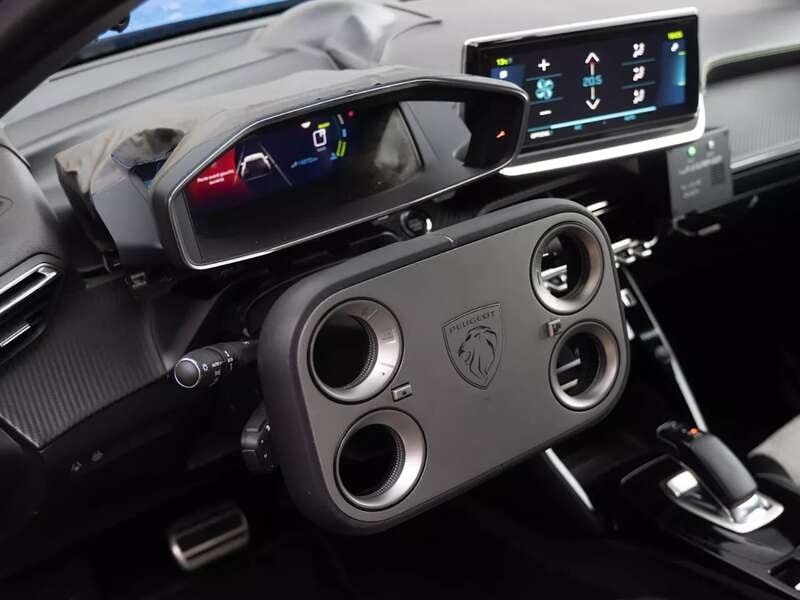
Peugeot Hypersquare replaces the traditional steering wheel with a rectangular controller developed for autonomous-capable vehicle interiors. The control interface is designed as a compact rectangle with rounded edges and integrates steering, acceleration, braking, and directional input into a single unit. It is mounted on a retractable system that allows the controller to disappear into the dashboard when not in use. Touch-sensitive surfaces and pressure-based inputs replace mechanical rotation.
The controller includes integrated displays, haptic feedback, and configurable controls intended to adapt to different driving modes. Steering input is handled through lateral movement rather than circular rotation, while acceleration and braking are controlled through pressure-sensitive zones. Materials and finishes align with Peugeot’s interior design language, combining smooth surfaces with embedded digital elements. The system is intended for future vehicles designed around autonomous driving scenarios, where traditional steering wheels are no longer required full time.
Image Credit: Peugeot
Key Themes Behind This Trend
- Adaptive Vehicle Controls
- This trend involves designing steering interfaces that adapt dynamically to various driving modes, enhancing user experience in autonomous-capable vehicles.
- Retractable Interface Technology
- There is a growing interest in developing control systems that can retract or hide when not in use, maximizing space efficiency in vehicle interiors.
- Pressure-based Input Systems
- The shift from mechanical to pressure-based inputs in vehicle controls is steering technological innovation towards more intuitive user interactions in the automotive sphere.
Where This Applies
- Automotive Design
- Innovations in steering controls such as the Hypersquare lead the automotive design industry towards more versatile and futuristic interior configurations.
- Human-machine Interface (HMI) Technology
- The integration of touch-sensitive surfaces and haptic feedback into vehicle controls is transforming the HMI industry, pushing for more seamless user-machine interactions.
- Autonomous Vehicles
- Evolving steering control systems reflect the expanding realm of the autonomous vehicles industry, where traditional driving interfaces are reimagined.