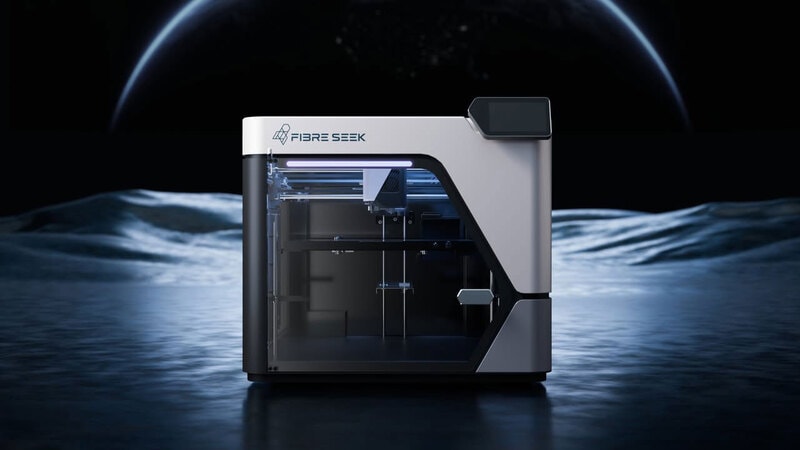
The FibreSeeker 3 is a composite 3D printer designed to make high-performance fiber-reinforced printing more accessible outside of large industrial settings. The machine supports the use of continuous fiber materials, including carbon fiber, fiberglass, and Kevlar, alongside thermoplastic base materials to produce structurally reinforced parts.
The system uses a dual-extrusion setup that allows fiber reinforcement to be integrated directly into printed components during fabrication. This approach enables parts to be produced with added strength while maintaining dimensional accuracy. FibreSeeker 3 is equipped with automated calibration and monitoring systems intended to support consistent print quality across longer production runs.
A large build volume allows for the fabrication of sizable components, while the enclosed structure helps maintain stable printing conditions. The printer interfaces with dedicated software that manages print preparation and fiber placement strategies.
Image Credit: FibreSeek
Why This Trend Is Growing
- Automated Calibration Systems
- The integration of automated calibration systems in 3D printing enhances precision and consistency, enabling users to achieve high-quality results without manual intervention.
- Continuous Fiber Integration
- Embedding continuous fibers like carbon fiber directly into 3D-printed parts paves the way for stronger and more durable components in lightweight applications.
- Large-scale 3D Printing
- The development of 3D printers with large build volumes allows for the production of considerable and intricate components, broadening the scope of feasible projects.
Industries Being Reshaped
- Aerospace Manufacturing
- By utilizing fiber-reinforced 3D printing, aerospace companies can manufacture robust components that meet stringent safety and performance standards.
- Automotive Industry
- Incorporating high-strength composite materials in 3D printing technology offers automotive manufacturers the ability to create lightweight and durable vehicle parts.
- Consumer Electronics
- 3D printing with advanced composite materials allows for innovative design and enhanced structural integrity in the development of consumer electronic devices.