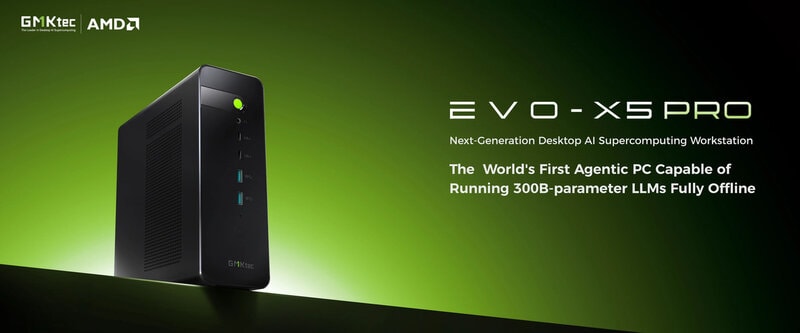
GMKtec is preparing desktop computing for more autonomous artificial intelligence with agentic AI PCs designed to process demanding workloads locally. The EVO-X5 Pro combines an AMD Ryzen AI Max+ PRO 495 processor with up to 192GB of unified memory, including up to 160GB dynamically allocated as graphics memory. With appropriate software and configurations, the compact PC can support local language models with up to 300 billion parameters, enabling developers and professionals to experiment with AI agents, private knowledge bases and AI-assisted workflows without relying entirely on cloud processing.
This local-first approach can give organizations greater control over sensitive data while potentially reducing latency and dependence on external computing infrastructure. For GMKtec, targeting agentic workloads moves the mini PC beyond conventional productivity and entertainment use. The high-memory configuration could also attract developers, researchers and businesses seeking compact hardware capable of supporting increasingly sophisticated AI applications.
Image Credit: GMKtec
Key Themes Behind This Trend
- Local AI Workstations
- Compact desktops with high unified memory are reshaping professional computing by bringing advanced model experimentation closer to sensitive enterprise data.
- Agentic Workflow Computing
- Autonomous AI agents running on personal hardware create new possibilities for private task automation, decision support and customized productivity systems.
- High-memory Mini Pcs
- Small-form-factor devices with workstation-scale memory capacity are expanding the role of mini PCs in research, development and AI prototyping environments.
Where This Applies
- Computer Hardware
- AI-ready processors and scalable memory architectures are redefining desktop product categories around local inference and autonomous workload performance.
- Enterprise Software
- Private AI deployments on local machines can support secure knowledge bases, workflow assistants and specialized applications with reduced cloud dependency.
- Data Privacy
- On-device processing offers businesses a path to advanced AI capabilities while maintaining tighter governance over proprietary, regulated or confidential information.