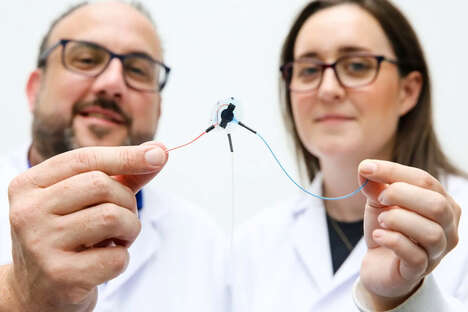
Over the past five years, Harvard scientists at the Wyss Institute for Biologically Inspired Engineering have been working away on a chip that could end animal testing forever. In July, a start-up company was created to commercialize these organ chips, which has the potential to save over 100 million lives of animals that are annually used to test a range of products.
The Lung-on-a-Chip is small, clear and veiny, designed to mimic a human's lungs and allow researchers to experiment with a variety of drugs to see how blood and lung cells respond. In the future, this technology will be able to provide insight into how individual people will respond to medications and products as well, since the chips are like miniature replicas of parts of the human body.
What Makes This Trend Stand Out
- Organ-on-a-chip
- Disruptive innovation opportunity: Advancing the development of other organ-on-a-chip technologies to replace animal testing in various fields.
- Personalized Medicine
- Disruptive innovation opportunity: Creating personalized drug treatments based on individual responses using organ-on-a-chip technology.
- Bioengineering
- Disruptive innovation opportunity: Applying bioengineering techniques to further enhance the capabilities and functionalities of organ-on-a-chip devices.
Sectors Adopting This
- Pharmaceuticals
- Disruptive innovation opportunity: Utilizing organ-on-a-chip technology to streamline drug discovery and testing processes, reducing reliance on animal testing and improving efficacy.
- Cosmetics
- Disruptive innovation opportunity: Employing organ-on-a-chip technology in cosmetics testing to ensure safety and efficacy without the need for animal testing.
- Biotechnology
- Disruptive innovation opportunity: Integrating organ-on-a-chip technology into biotech research and development processes, enabling more accurate and efficient drug screening and development.