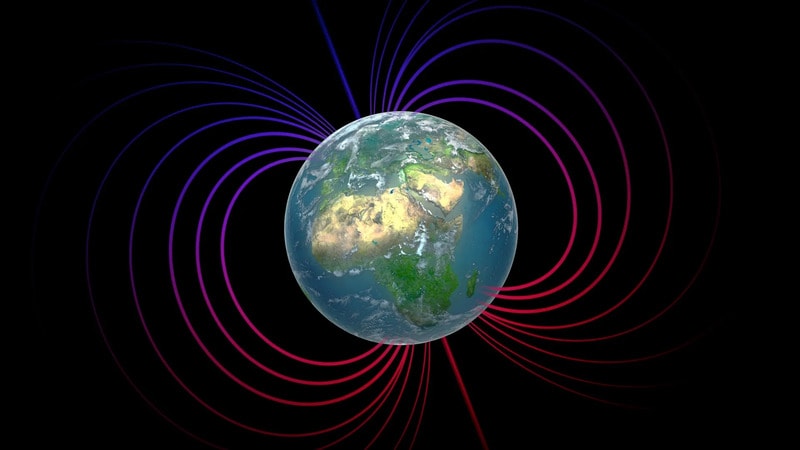
Researchers at the University of Liverpool published a study introducing two continent-sized, deep hot rock structures at the base of the mantle, featuring localized hot zones beneath Africa and the Pacific that affect the liquid outer core. The team "combined palaeomagnetic records with supercomputer geodynamo simulations to trace magnetic behavior over the past 265 million years."
The work reconstructed ancient magnetic fields and ran numerical models that showed sharp thermal contrasts at the core–mantle boundary, with hotter regions linked to stalled outer-core flow and cooler rings supporting vigorous circulation. The DEEP group collaborated with University of Leeds scientists and used extensive computational resources to map how these deep features correlate with long-term magnetic stability and change.
For consumers of science—researchers, educators and policy makers—this clarifies a persistent unknown about Earth’s interior and improves models used in geophysics and paleoclimate studies. By tying mantle heterogeneity to magnetic patterns, the study refines how the planet’s long-term magnetic behavior is interpreted and applied across Earth science fields.
Image Credit: ScienceDaily
What's Driving This Trend
- Geothermal Anomalies
- Mapping localized hot zones beneath the Earth can lead to breakthroughs in understanding geothermal energy resources.
- Magnetic Field Evolution
- Studying continent-sized hot structures offers insights into the historical changes of Earth’s magnetic field, paving the way for new magnetic phenomena research.
- Core-mantle Dynamics
- Detailed models of deep-seated thermal contrasts promote innovations in predicting planetary magnetic and geological activities.
Who This Affects Most
- Geophysics
- Integrating computational simulations into geophysical research transforms how scientists comprehend Earth's magnetic and thermal behaviors.
- Climate Science
- Enhanced models resulting from this study aid in more accurate paleoclimate reconstructions, impacting long-term climate forecasting.
- Computational Modeling
- Advanced simulations of Earth's core-mantle interactions drive progress in computational methods applied to planetary sciences.