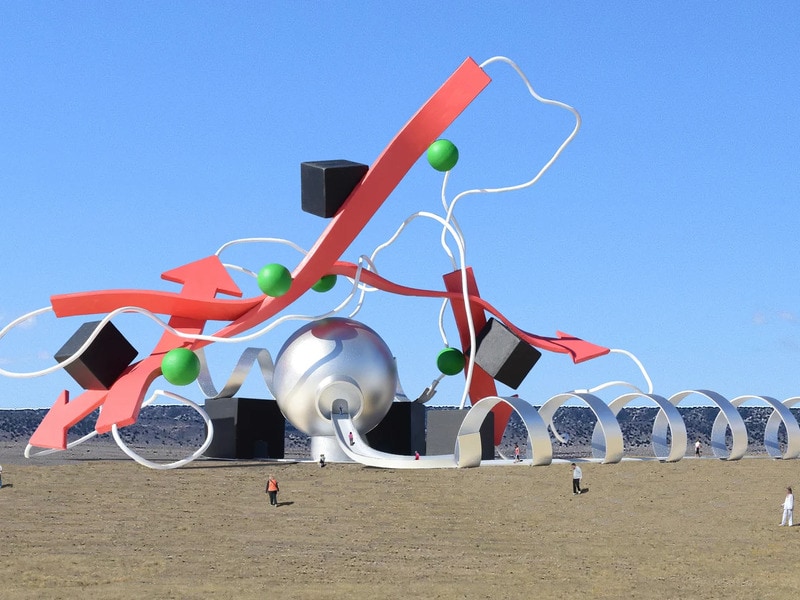
Folded Protein Molecule Research and Exhibition Center is a conceptual building designed to resemble an exploded protein diagram, scaling up the symbolic coils, arrows, and connecting rods scientists use to visualise protein folding into full-sized architectural elements.
The design by Michael Jantzen positions functional research spaces within solid volumes such as black-clad cubes for laboratories and a larger silver sphere for exhibition halls, while bright coloured arrows, loops, and rods weave through and around these volumes, presenting an abstract protein structure that visitors can experience spatially. Approach paths and canopies formed by arching elements guide movement across an open landscape toward the sphere’s base, creating a journey through symbolic geometry before entering interior spaces.
The concept positions the building as both a research facility and a public exhibition venue, blurring conventional building typologies by making the architectural form itself the subject of scientific storytelling rather than a neutral container. Portions of the solid volumes are clad in solar panels, allowing symbolic surfaces to contribute to onsite energy generation. The interwoven symbolic loops and arrows rise above the ground plane, inviting interaction with the network of forms as one would explore a large-scale sculpture or landscape intervention.
Image Credit: Michael Jantzen
What's Driving This Trend
- Biomimicry in Architecture
- Increasing use of protein-inspired designs in architecture fosters sustainable and aesthetically innovative structures, challenging traditional architectural norms.
- Symbolic Storytelling Structures
- Buildings designed to convey scientific narratives through their forms are transforming how educational and research spaces engage the public.
- Integration of Art and Function
- Architectural designs that double as artistic exhibitions offer multifunctional spaces that engage users on an intellectual and emotional level.
Who This Affects Most
- Sustainable Architecture
- The incorporation of solar panels within symbolic building designs aligns with the growing demand for eco-friendly energy solutions in the construction industry.
- Science Communication
- Public exhibition venues that use architecture to visualize scientific concepts are redefining how complex information is disseminated to diverse audiences.
- Landscape Architecture
- The use of architectural elements that create guided spatial experiences through open landscapes presents new possibilities for interactive outdoor design.