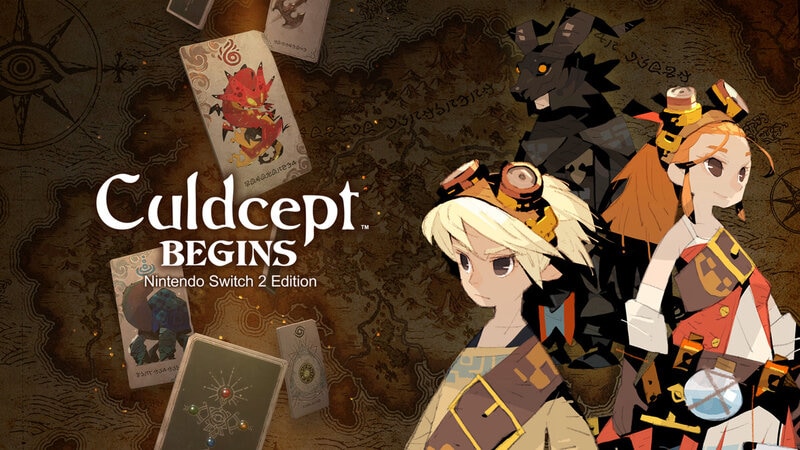
Originally released on the Sega Saturn in 1997, Culdcept is a Japanese role-playing game that features unique gameplay that blends board game, deckbuilding, and RPG mechanics into one. Since its original title, the game grew into a wide-spanning franchise with numerous games and expansion packs across various platforms, such as Playstation 2, Nintendo DS, and more.
In 2026, Neos Corporation is aiming to revive the Culdcept franchise with two titles: Culdcept: BEGINS, a full-scale, brand-new title for modern audiences, and Culdcept: The First, a remaster of the original title from 1997. To focus on Culdcept: BEGINS, the title is available on Nintendo Switch 1, Switch 2, and PC via Steam, with the Switch 2 and Steam version supporting high 4k resolutions at full 60fps framerates, and the Switch 1 title running at a lower resolution of 1080p, though still with stable framerates.
As for the game itself, players follow the story of Kamru, a young magician, called a Cepter in the world, who is a prodigy that expertly manipulates Culdcept cards in battles against other students and foes alike. Throughout the story, Kamru grows from becoming a young student prodigy to becoming an official member of the Royal Cepter Guard Regiment. As we assume the role of Kamru, we are given the task of protecting the kingdom from creatures from the Abyss while also learning about who Kamru is, where he came from, and the origins of his prodigal skill in Cepter magic. The story is slow to start, but once it picks up it becomes a gripping, sprawling tale with excellent writing and intense moments that keep players hooked to the end.
The gameplay is perhaps the most unique aspect of Culdcept: BEGINS. In a match, players are positioned along a board game-style play area complete with blank tiles and event tiles. Players alternate taking turns in a consistent order. Each turn, players begin by rolling a dice that determines how many tiles they will move. Then, upon landing on an empty tile, players may play one creature or spell card from their hand. Creature cards played will occupy the current tile, while spell cards vary greatly in effect, but usually target either a player or creature on the map and either deal damage, buff, debuff, move, or otherwise interact with the selected target. Additionally, once creatures are already placed, players are able to instead spend their turn to upgrade one of their own creatures to improve its strength and resource generation.
Once a few turns have passed, the board becomes full of various creatures and hazards. When a player lands on another participants creature, combat begins. In combat, the one who landed on the tile must select a creature from their hand to fight the creature on the board, with each creature having a unique element, bonus, health, and damage stat. Winning a fight clears the tile, while losing the fight sacrifices your selected creature and incurs a toll of the game's main currency, G, officially called Magic in the game, while colloquially called Gold by other players.
The game's win condition revolves around G. Nearly every interaction in the game either costs, or rewards, G. Players can acquire G by defeating creatures, incurring tolls on other players, landing on unique event tiles, completing full laps around the board, and in other unique ways. Once a player has reached the necessary amount of G to win the round, the game ends and the player is declared the winner.
While the gameplay is incredibly deep and seemingly daunting to pick up when you first begin your journey, the flow of the game quickly becomes intuitive and addictive as players discover different strategies to play the game the way they prefer. While some players focus more on spells and board control, others may focus on laying mass amounts of weaker creatures, while others may make a few creatures incredibly strong, and these examples only scratch the surface of what is possible once the game's mechanics are fully grasped.
Aside from the campaign mode and modes versus NPCs, the game also supports PvP online in both casual and ranked matches, meaning there is a lot of depth to be discovered, and lots of replayability for players who enjoy the gameplay loop and want to fully master their craft against others.
Overall, Culdcept: BEGINS is an incredibly unique JRPG that brings a breath of fresh air to the genre for most players in North America, as the previous titles only really grew to popularity in Japan, and were considered more niche in the North American markets. The game shows exciting promise as both a casual title for Switch players who want a unique board game to play on the go, as well as a detailed, intricate game for serious players who want to optimize every turn on either Switch or Steam. If you are interested in either the Switch 1, Switch 2, or Steam version of the game, each are linked above for more information.
Image Credit: Neos Corporation
What Makes This Trend Stand Out
- Hybrid-genre Revivals
- Cult franchises combining board game, deckbuilding, and RPG systems are creating fresh market space for legacy IPs rebuilt around modern player expectations.
- Portable Strategy Depth
- Complex tactical experiences on Switch and PC highlight demand for games that balance handheld accessibility with deep competitive mastery.
- Remastered-origin Pairings
- Launching a new entry alongside a remastered original gives publishers a pathway to serve nostalgia-driven fans while onboarding unfamiliar audiences.
Sectors Adopting This
- Video Games
- Genre-blended titles with online ranked play point to opportunities in expanding niche Japanese franchises into broader global strategy markets.
- Digital Collectibles
- Card-based progression and customizable tactical decks suggest potential for richer digital ownership models, cosmetics, and expansion-driven ecosystems.
- Entertainment Software
- Cross-platform performance optimization across console generations and PC reflects growing value in scalable releases that reach casual and enthusiast players simultaneously.