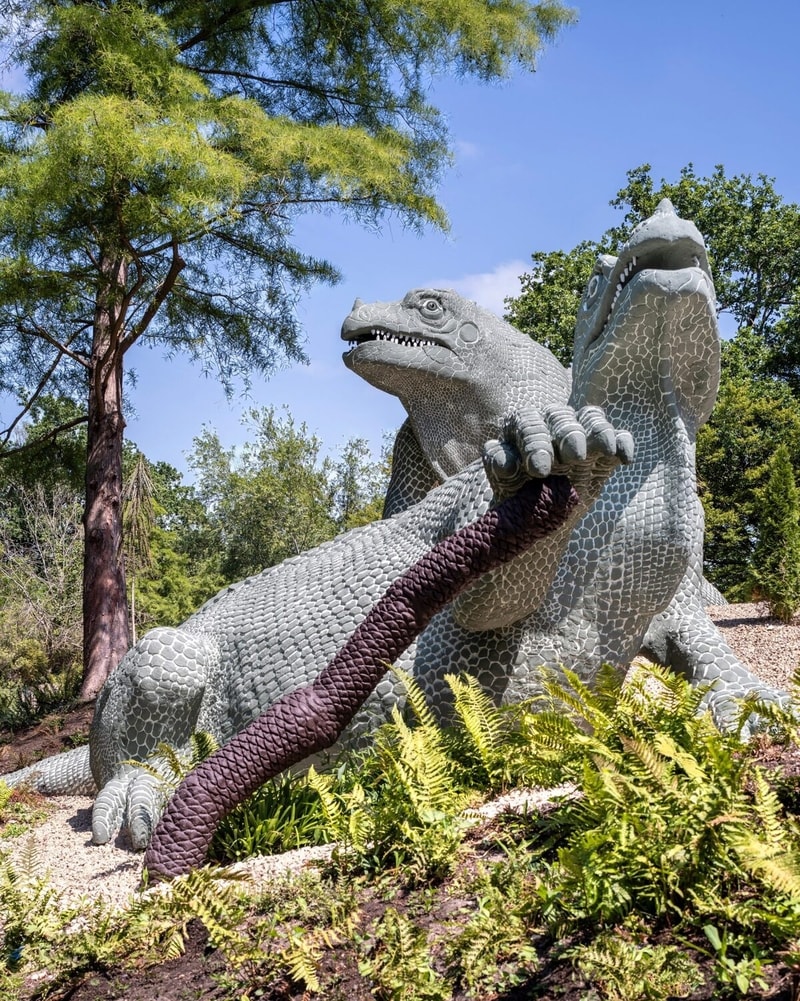
The Crystal Palace dinosaurs have been restored by HTA Design and Donald Insall Associates as part of the wider regeneration of Crystal Palace Park in south London. The 172-year-old concrete sculptures, believed to be the world's first life-sized dinosaur models, underwent extensive conservation that included structural repairs, reinstated missing elements using 3D printing, and a new paint scheme informed by historical research. The surrounding landscape, including pathways, lakes, islands, waterfalls, and the Geological Court, was also refurbished to strengthen the relationship between the sculptures and their setting.
The restoration has resulted in the dinosaurs being removed from Historic England's Heritage at Risk Register while supporting the park's broader revitalization led by Bromley Council and Crystal Palace Park Trust. The project also restored the Grade II-listed Italian Terraces and Grand Centre Walk, alongside the addition of a visitor centre and a dinosaur-inspired playground.
Image Credit: Kilian O'Sullivan
What Makes This Trend Stand Out
- 3d-printed Heritage Repairs
- Additive fabrication enables historically sensitive replacement parts for aging monuments, creating new markets for precision conservation tools and archival reconstruction workflows.
- Immersive Park Regeneration
- Public landscapes that combine restored heritage assets, visitor centers, and themed play areas signal demand for experience-led civic destinations with diversified community value.
- Research-based Color Restoration
- Historically informed paint schemes are elevating conservation authenticity, opening space for material analysis services, digital archives, and specialized heritage finishes.
Sectors Adopting This
- Cultural Heritage Conservation
- Advanced structural repair, 3D modeling, and historical research are reshaping restoration practices for landmark assets with tourism and education potential.
- Urban Park Development
- Regeneration projects that connect ecological design, public access, and cultural storytelling are expanding the role of parks as multi-use civic infrastructure.
- Museum and Visitor Attractions
- Dinosaur-inspired interpretation, play environments, and onsite learning facilities reflect a growing crossover between heritage preservation and family-focused destination design.