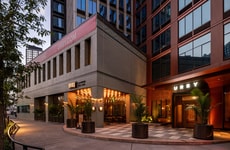

Concrete Amsterdam recently designed a high-rise building that was intended to integrate seamlessly with its urban surroundings while fostering a sense of community among its inhabitants.
The Journal Square Urby is a 25-story structure containing 340 residential units. The development is conceived to act as a transitional element between a district of taller buildings and an adjacent neighborhood of lower-scale homes. Concrete Amsterdam's architectural approach incorporates a base with street-level public spaces — including a café that is accessible to both residents and the wider public — and a series of communal amenities on the top floor, such as a kitchen, garden room, and a rooftop pool. A large-scale mural covering one side of the building also immediately captures attention.
Image Credit: Robert Tsai
Key Themes Behind This Trend
- Community-centric Architecture
- Architectural designs emphasizing communal spaces present new opportunities for fostering social connectivity in urban environments.
- Mixed-use Developments
- The integration of public and private spaces within high-rise buildings can enhance community engagement and blur the lines between residential and commercial areas.
- Sustainable Urban Integration
- Innovations in blending high-rise structures with local neighborhoods can lead to more cohesive urban development, respecting both density and community identity.
Where This Applies
- Urban Real Estate Development
- Real estate developers can revolutionize urban landscapes by prioritizing projects that incorporate communal and public spaces in high-density areas.
- Architecture and Design
- The architecture industry stands to innovate by creating designs that enhance community interaction and integrate seamlessly into existing urban fabric.
- Hospitality and Leisure
- By incorporating amenities like cafes and rooftop pools, the hospitality sector can expand within residential high-rises, offering new social and leisure opportunities for city dwellers.