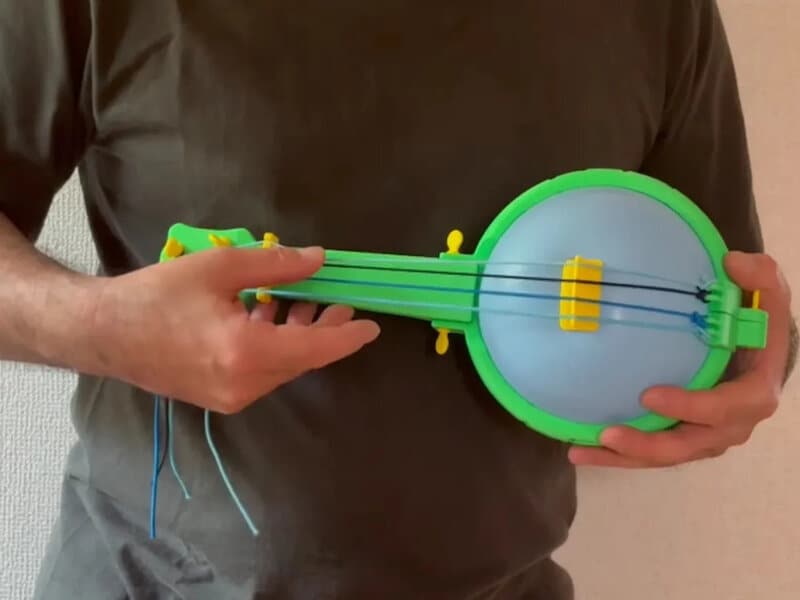
Balloon Banjo is a 3D-printable musical instrument that uses an inflated party balloon as its acoustic sounding board. The design consists of 19 printable parts assembled into seven larger components, with nylon fishing line serving as the strings. Air pressure inside the balloon influences how the rubber surface vibrates, allowing users to adjust the instrument's resonance by inflating or deflating the balloon. The frame secures the balloon beneath the strings, creating a lightweight construction that demonstrates the relationship between string vibration and sound production through a simple mechanical setup.
Created by Co Lab, the instrument is assembled without metal fasteners, relying on 3D-printed plastic screws that can be tightened by hand. The hardware was sized to simplify construction for children and families while eliminating the need for specialist tools or adhesives. Design files are available for download, allowing users to fabricate the components with a 3D printer before adding filament, fishing line, and a standard party balloon.
Image Credit: Co:Creation Lab
Key Themes Behind This Trend
- Printable Acoustic Instruments
- Open-source fabrication files and low-cost components create room for customizable musical devices that can be produced locally for education, experimentation, and home use.
- Balloon-based Sound Design
- Adjustable air pressure transforms a simple party balloon into a tunable acoustic surface, suggesting new possibilities for playful, low-cost resonance systems.
- Tool-free Maker Kits
- Hand-assembled plastic fasteners and simplified part design point to family-friendly fabrication models that reduce barriers to hands-on STEM and music learning.
Where This Applies
- Music Education
- Low-cost printable instruments can make sound physics more accessible in classrooms by combining performance, assembly, and experimentation in one tactile format.
- 3D Printing
- Downloadable instrument designs highlight opportunities for consumer fabrication platforms to support functional, creative products beyond decorative objects.
- Toy and Game Design
- Hybrid play objects that merge craft, music, and science offer new formats for interactive toys centered on personalization and discovery.