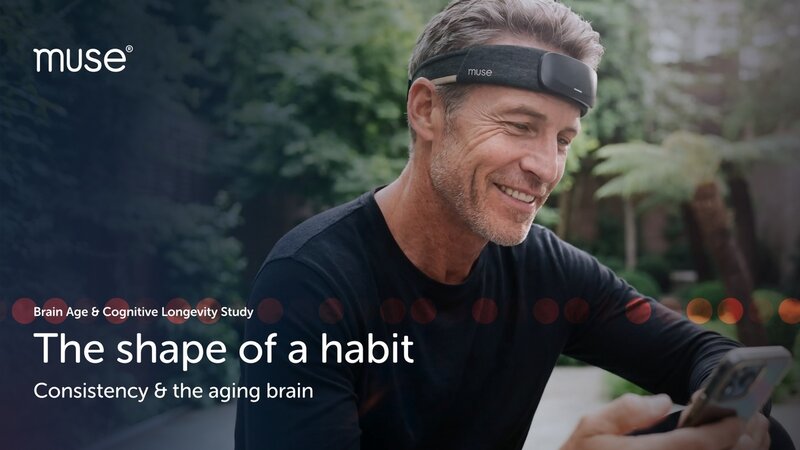
Brain-health wearable company Muse by Interaxon Inc. has published a new analysis of its at-home EEG data showing that consistent practitioners in their 60s and 70s outperformed sporadic users three decades younger on a demanding attention test. As part of the research inquiry, the regularity of training emerged as a stronger predictor of cognitive performance than either age or total practice time.
Muse's study drew on roughly 53,000 biofeedback training sessions logged across 189 users aged 31 to 83 over the course of a year. Cognitive control was measured through 1,228 completions of the same Stroop attention test , where users must name the color of a mismatched ink while overriding the automatic urge to read the word. Across every age group, those who trained in most weeks were 40 to 50 milliseconds faster at dealing with conflicting information than sporadic users, with consistent practitioners in their 60s and 70s averaging 192 milliseconds of interference compared to 219 milliseconds for sporadic users in their 30s and 40s.
Image Credit: Muse by Interaxon Inc.
Why This Trend Is Growing
- At-home Neurofeedback
- Consumer EEG platforms are expanding brain-training beyond clinics, creating new models for continuous cognitive support, personalized feedback, and remote performance tracking.
- Consistency-based Wellness Metrics
- Regular engagement is emerging as a more meaningful health indicator than age or total usage, opening space for habit-driven analytics in digital wellness products.
- Cognitive Longevity Wearables
- Brain-health devices are reframing aging around measurable attention and control outcomes, supporting new offerings for older adults seeking proactive cognitive maintenance.
Industries Being Reshaped
- Digital Health
- Remote biofeedback data enables scalable brain-health monitoring, with platforms positioned to integrate cognitive assessment into preventative care ecosystems.
- Wearable Technology
- EEG-enabled consumer devices are broadening the wearable category from fitness tracking to neurological insight, encouraging differentiation through clinically relevant mental performance data.
- Aging and Longevity
- Cognitive training tools for older populations introduce fresh opportunities for age-tech services centered on independence, mental resilience, and long-term wellness engagement.