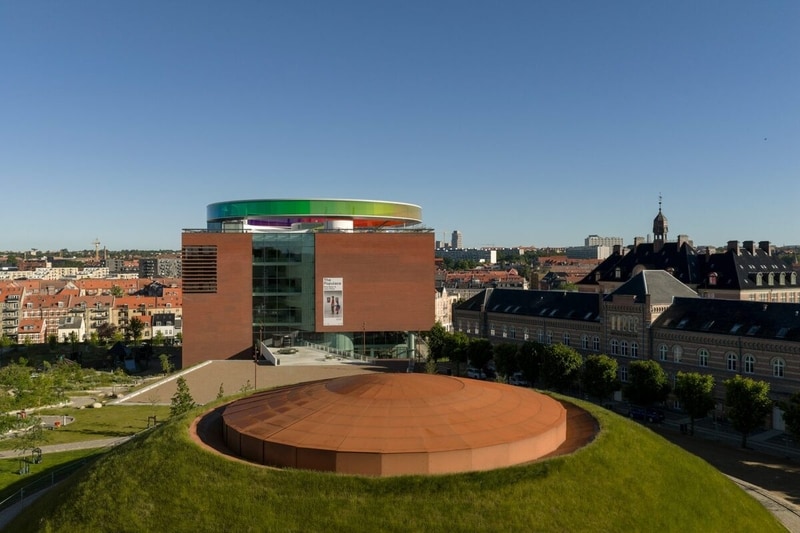
American artist James Turrell has completed As Seen Below at the ARoS Aarhus Art Museum in Denmark, marking the 100th installation in his celebrated Skyspace series. Created in collaboration with architecture studio Schmidt Hammer Lassen, the project forms the centerpiece of the museum’s 4,000-square-metre Next Level expansion. The immersive work is housed within a 40-metre-wide subterranean dome, where a six-metre-wide aperture at the apex frames changing views of the sky above. Inside, carefully controlled lighting washes the space in shifting monochromatic colors, transforming perception and emphasizing the experience of looking itself.
The installation is accessed through a redesigned park landscape and an underground corridor connecting it to the existing museum. Stepped seating wraps around the expansive interior, which is finished with raw concrete, brick paving, and a central stone-covered drainage area. Above ground, the structure appears as a grass-covered mound capped by an operable lid that can close the oculus and function as a lighting element.
Image Credit: Adam Mørk
What's Driving This Trend
- Subterranean Cultural Spaces
- Underground galleries and domed venues create new potential for climate-conscious expansion, immersive programming, and landmark architecture with reduced above-ground visual impact.
- Sky-framing Installations
- Aperture-based artworks transform natural light and weather into dynamic content, opening pathways for low-energy experiential environments that change throughout the day.
- Landscape-integrated Museums
- Grass-covered structures and park-connected entrances blur boundaries between public space and cultural infrastructure, positioning museums as hybrid civic, recreational, and artistic destinations.
Who This Affects Most
- Museums and Galleries
- Immersive permanent installations provide cultural institutions with differentiated visitor experiences that extend dwell time, membership value, and global destination appeal.
- Architecture and Design
- Collaborations between artists and architects are reshaping spatial storytelling through sensory environments, material minimalism, and infrastructure that functions as both building and artwork.
- Experiential Tourism
- Monumental art environments support travel demand for rare, site-specific encounters, giving destinations new cultural assets that compete beyond traditional sightseeing.