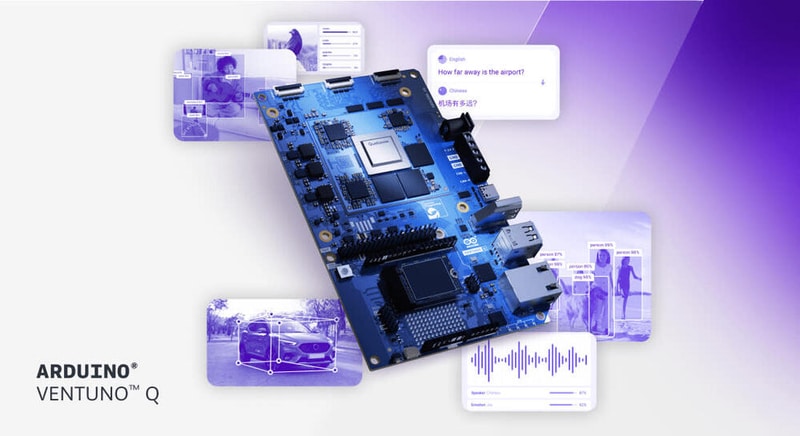
The Arduino Ventuno Q is a new single-board computer introduced by Qualcomm and Arduino, designed for robotics and edge AI applications, featuring Qualcomm's Dragonwing IQ8 processor with an integrated Hexagon Tensor NPU and a dedicated STM32H5 low-latency microcontroller. It shipped with 16 GB of LPDDR5 memory, 64 GB eMMC storage, an M.2 NVMe Gen4 slot and connectivity like Wi‑Fi 6, Bluetooth 5.3 and 2.5 Gbps Ethernet, supporting USB camera input for vision tasks.
Arduino bundled App Lab with pre-trained offline models—LLMs, VLMs (vision-language models), ASR and pose and object-tracking—plus a full robotics stack that pairs vision processing with deterministic motor control. Priced under $300 and slated for Q2 2026 availability, Ventuno Q aims to move AI from cloud-dependent prototypes into physical machines for education, kiosks, healthcare assistants and edge sensing, enabling low-latency, on-device perception and action.
Image Credit: Arduino
Key Themes Behind This Trend
- Edge-AI Robotics
- A move to low-latency, on-device perception and deterministic motor control that enables autonomous behaviors in compact robots without cloud dependency.
- On-device Multimodal Models
- Pretrained LLMs, VLMs and ASR running offline on single-board computers that allow real-time multimodal inference for interactive physical systems.
- Affordable Developer-grade Sbcs
- High-performance, sub-$300 single-board computers with NVMe, ample RAM and dedicated NPUs that lower the barrier for prototyping production-ready robotic products.
Where This Applies
- Education Technology
- Hands-on STEM platforms incorporating local AI and robotics stacks that transform classroom learning from simulated code to physical, perceptive machines.
- Healthcare Robotics
- Compact assistants and monitoring kiosks with on-device vision and speech understanding capable of delivering low-latency patient interactions in clinical environments.
- Industrial Automation
- Edge-enabled sensing and control nodes with integrated NPUs and microcontrollers that support deterministic, real-time inspection and motion tasks on the factory floor.