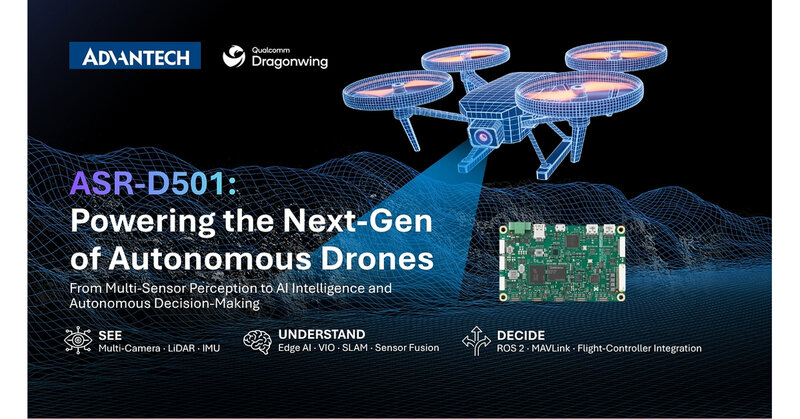
Advantech is advancing autonomous drone development with the ASR-D501, a compact AI companion and mission computer built for size, weight, and power-constrained UAVs. Powered by the Qualcomm QCS6490, the platform delivers up to 12 TOPS of AI performance while consuming less than 10 watts. It processes object detection, visual localization, sensor fusion, obstacle awareness, and other perception tasks directly onboard, reducing dependence on continuous cloud connectivity. Multi-camera and sensor interfaces further support complex autonomous missions.
For drone developers, combining AI processing, connectivity, and flight-controller integration within one 50g platform can reduce hardware and software integration complexity. Advantech’s pre-integrated robotics software also helps shorten the path from prototyping to deployment. Commercially, the system positions Advantech to serve expanding industrial UAV applications while creating opportunities across autonomous inspection, mapping, navigation, and other data-intensive drone operations.
Image Credit: Advantech Co., Ltd.
Key Themes Behind This Trend
- Edge-AI Drones
- Compact onboard processors are enabling UAVs to make perception and navigation decisions locally, creating new possibilities for low-latency autonomous missions in areas with limited connectivity.
- Integrated Flight Computing
- Combining AI, connectivity, sensor inputs, and flight-controller support into lightweight modules reduces development complexity and opens the market to faster drone prototyping and deployment.
- Autonomous Sensor Fusion
- Multi-camera and sensor processing aboard drones is expanding machine perception capabilities, allowing richer inspection, mapping, and obstacle-awareness services without constant cloud reliance.
Where This Applies
- Commercial Drone Services
- Local AI processing strengthens autonomous inspection, surveying, and monitoring models by supporting more reliable operation across industrial sites and remote environments.
- Robotics Hardware
- Low-power mission computers designed for constrained platforms are reshaping component ecosystems around smaller, more capable, and easier-to-integrate autonomous machines.
- Industrial Mapping
- Data-intensive aerial mapping benefits from onboard visual localization and perception, increasing the feasibility of real-time spatial intelligence for infrastructure, energy, and logistics applications.