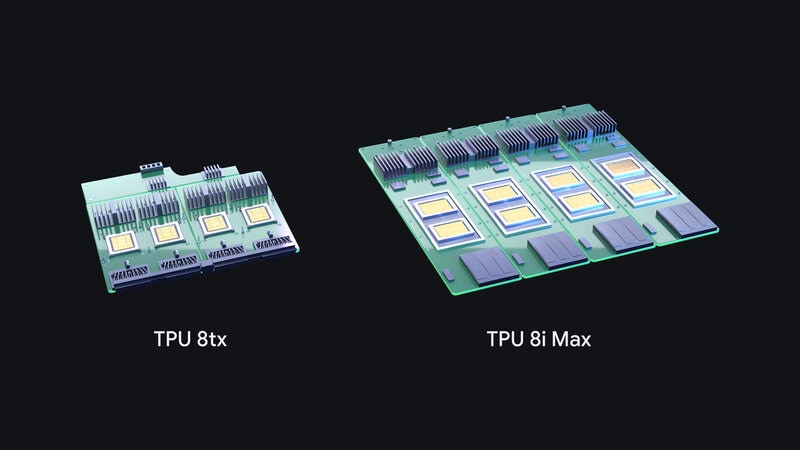
Google expanded its eighth-generation TPU hardware with ‘TPU 8tx’ and ‘TPU 8i Max,’ giving agentic AI workloads one option for protected inference and another for larger context handling. The additions bring the TPU family to four systems in one year and target regulated enterprises, governments and other teams handling sensitive models.
TPU 8tx keeps data and model weights isolated while they are processed, and it can cut latency by up to 2x for multi-step agents. TPU 8i Max combines two TPU 8i chips in one package, doubling compute and memory bandwidth for long prompts, codebases and video-heavy tasks.
Google shows how hardware-level confidential compute can make TPU 8tx a fit for buyers that fine-tune and run agents without moving private data between clusters, while a design doubling compute in the same rack footprint turns TPU 8i Max into a density play for data center operators.
Image Credit: Google
Why This Trend Is Growing
- Confidential AI Inference
- Hardware-isolated processing creates new value for enterprises that need agentic AI performance without exposing proprietary data or model weights.
- Long-context Acceleration
- Expanded memory bandwidth and compute density support more complex prompts, code analysis and multimodal workloads that stretch beyond conventional AI infrastructure.
- Agentic AI Infrastructure
- Specialized chips built for multi-step reasoning reduce latency barriers for autonomous systems operating across regulated, data-intensive environments.
Industries Being Reshaped
- Cloud Computing
- Secure and denser accelerator options reshape how cloud providers package AI infrastructure for privacy-sensitive and high-throughput customers.
- Government Technology
- Confidential compute capabilities make advanced AI agents more viable for public-sector use cases involving restricted data and compliance-heavy workflows.
- Data Centers
- Higher compute capacity in the same rack footprint introduces efficiency gains for operators balancing AI demand, space constraints and power economics.