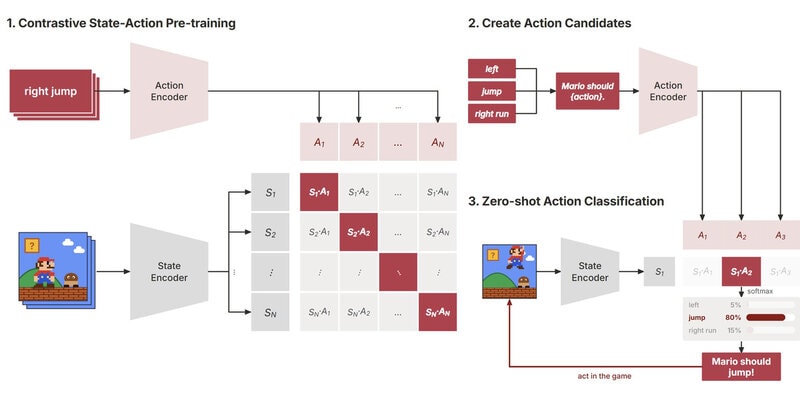
Stanford and Nvidia built 'CLM-8B' so AI agents can choose from a bounded set of actions without generating a full-text reply. The contrastive language model (CLM) encodes the current state and candidate actions, then selects the closest match for faster routing and ranking within workflows.
Built on a frozen Qwen3-8B backbone with separate heads for states and actions, the model can cache recurring action embeddings rather than recomputing them each time. In zero-shot tests, it ran up to 9x faster than TypeSafe's Jev, especially when the same options were reused across many requests.
For providers, CLM-8B offers a dedicated decision layer for tasks like tool routing or ticket triage, where the menu of choices remains stable. That could reduce latency across long agent chains and leave larger reasoning models focused on generating answers rather than repeatedly choosing among them.
Image Credit: CLM Team
What's Driving This Trend
- Bounded Action Models
- AI systems that choose from predefined options create room for lower-latency agent workflows where routine decisions no longer require full generative responses.
- Cached Action Embeddings
- Reusable action representations introduce efficiency gains for high-volume enterprise tasks that rely on stable menus, queues, or tool sets.
- Agent Decision Layers
- Dedicated routing models separate selection from reasoning, enabling modular AI stacks that optimize cost, speed, and accuracy across complex workflows.
Who This Affects Most
- Enterprise Software
- Workflow platforms can incorporate faster AI routing to streamline ticket triage, task assignment, and tool selection inside existing business systems.
- Customer Support
- Support operations benefit from bounded-choice intelligence that classifies issues and routes cases without slowing down escalation or response pipelines.
- Cloud AI Infrastructure
- Model providers have new opportunities to offer specialized decision services that reduce compute demand across repeated agentic actions.