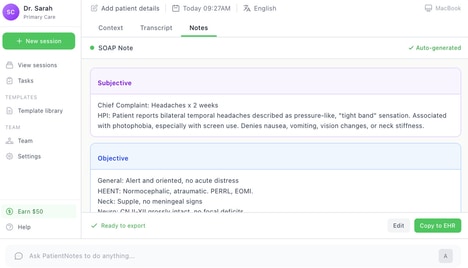

Ambient clinical intelligence is transforming healthcare administration by embedding AI directly into clinical workflows instead of limiting it to documentation alone. Austin Regional Clinic's enterprise deployment of Suki demonstrates how ambient AI can automate clinical note creation, support evaluation and management coding, and integrate with existing electronic health record systems without disrupting provider workflows. The platform reduces documentation time while improving coding accuracy, allowing clinicians to spend more time focused on patient care rather than administrative tasks.
For healthcare organizations, this approach highlights the growing value of AI systems that streamline multiple operational processes through a single platform. Reducing administrative workload can improve clinician satisfaction while supporting more accurate reimbursement and greater financial efficiency. As health systems continue facing staffing shortages and rising operational costs, ambient clinical intelligence platforms could become an essential part of modern care delivery, helping providers scale services while maintaining productivity and improving the overall patient experience.
Image Credit: Suki
What's Driving This Trend
- Ambient Workflow AI
- Healthcare teams gain new efficiency from AI embedded directly into daily clinical processes, creating space for platforms that manage documentation, coding, and workflow support in one environment.
- Automated Medical Coding
- Revenue-cycle performance becomes more precise as clinical AI interprets encounters and supports evaluation and management coding with reduced manual burden.
- Clinician Productivity Platforms
- Administrative relief emerges as a competitive differentiator for health systems adopting tools that improve provider satisfaction while preserving patient-facing time.
Who This Affects Most
- Healthcare Technology
- Integrated AI systems are reshaping digital health infrastructure by connecting clinical documentation, coding, and electronic health record workflows.
- Hospital Administration
- Operational leaders face growing demand for intelligent automation that offsets staffing constraints, improves reimbursement accuracy, and supports scalable care delivery.
- Electronic Health Records
- EHR ecosystems are expanding through ambient intelligence integrations that make core record systems more adaptive, automated, and clinician-friendly.