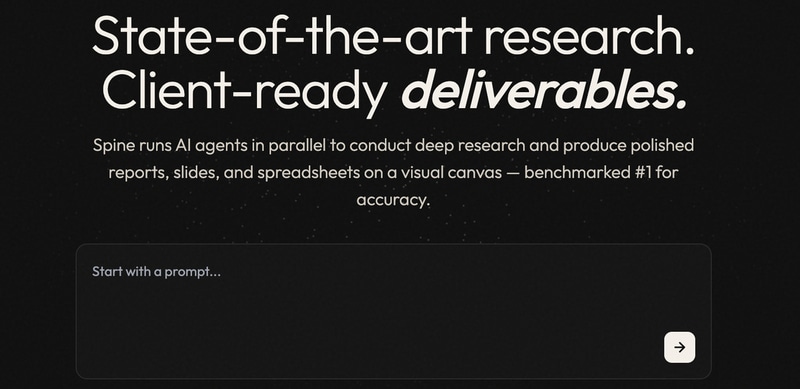
Spine is a visual workspace designed for deploying and coordinating multiple AI agents from a single platform. It helps users manage complex workflows that span research, content creation, and productivity tasks.
The platform allows AI agents to browse the web, perform deep research, generate long-form strategy documents, build presentations, and create interactive prototypes from a single prompt. This reduces the need to manually coordinate multiple tools. Its interface is built around visual workflow management, making it easier to organize and monitor how different agents contribute to a task. The goal is to simplify large-scale AI-assisted work.
Spine is aimed at teams and professionals looking to automate high-effort digital workflows. By combining multiple AI agents into one workspace, it enables more advanced task execution across apps and systems.
Image Credit: Spine
What's Driving This Trend
- Multi-agent Orchestration
- A platform-centric approach that coordinates specialized AI agents across tasks presents opportunities to replace fragmented toolchains with coherent, interdependent agent ecosystems.
- Visual Workflow Management
- Graphical interfaces for mapping agent interactions create scope for composable, inspectable workflows that make complex multi-step automation understandable to nontechnical stakeholders.
- Unified Agent Interfaces
- Consolidating browsing, research, content generation, and prototyping controls into a single prompt-driven UI enables novel integrations between previously siloed capabilities and data sources.
Who This Affects Most
- Enterprise Software
- Large organizations could benefit from platforms that orchestrate AI agents to streamline cross-departmental processes and reduce reliance on bespoke integrations.
- Marketing and Content
- Content teams stand to gain from end-to-end agent workflows that convert briefs into researched long-form strategies, presentations, and interactive prototypes with consistent brand voice.
- Research and Development
- R&D groups may leverage agent-managed pipelines for continuous literature review, experiment planning, and synthesis of findings across disparate data sources.