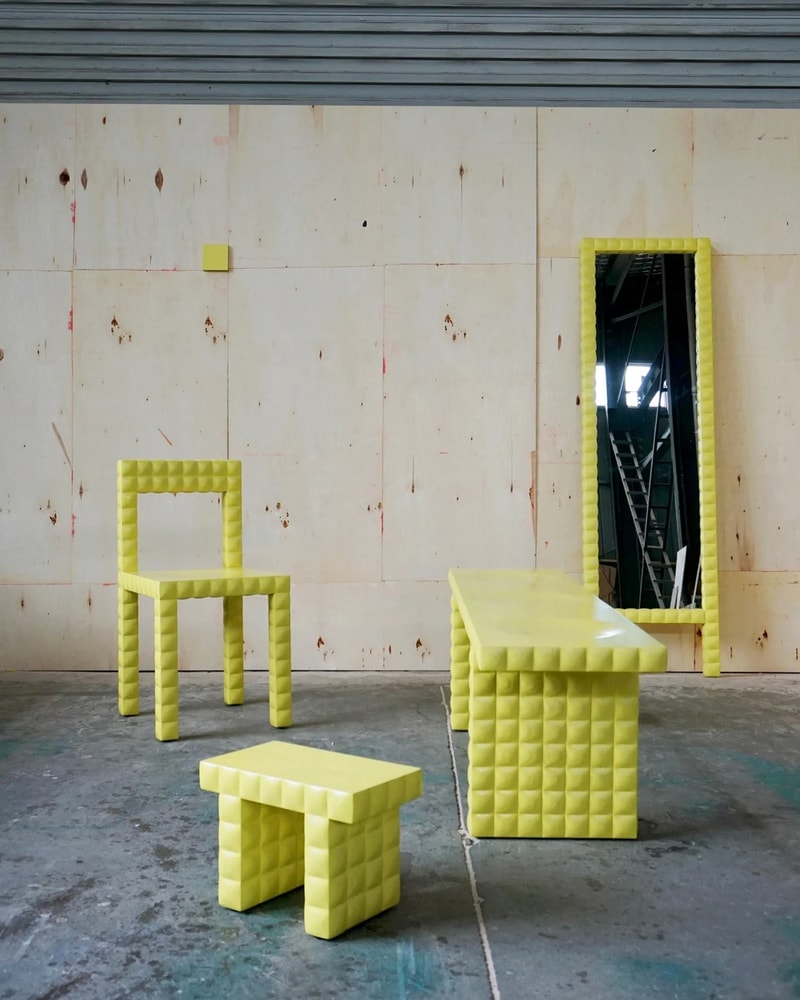
The Squares collection by One Week Design is a series of chairs, stools, benches, and mirrors developed from a strict grid system based on 5×5 centimeter units. Designed by Xiaoya Wang and Jian Ni, each piece is constructed as a composition of repeated square modules, creating a highly controlled structure that defines both form and proportion. The design reduces furniture to essential elements, using geometric consistency to produce objects that feel precise, balanced, and fully resolved.
The collection draws from Wang’s childhood experience learning bricklaying alongside her father, where repetition, alignment, and structural rhythm informed the design process. This influence is translated into wooden forms with subtly convex surfaces that catch light across each module, adding depth to the otherwise rigid geometry. Constructed from solid ash wood with water-based finishes, the pieces are available in a range of bold and neutral colors, allowing the system to shift between sculptural presence and functional seating within different interior contexts.
Image Credit: One Week Design
Why This Trend Is Growing
- Modular Grid Design
- A standardized 5×5 centimeter-module system enables configurable products that can be recombined to meet diverse spatial and aesthetic needs, challenging bespoke-only design models.
- Material-driven Minimalism
- Precision-focused reduction to essential forms paired with subtle material finishes creates high-design products that can command premium margins through perceived craftsmanship.
- Craft-informed Industrial Design
- Integration of traditional craft techniques like bricklaying-inspired repetition into industrial production fosters hybrid offerings that blur the line between artisan objects and mass-manufactured furniture.
Industries Being Reshaped
- Modular Furniture Manufacturing
- Manufacturing lines built around repeatable module units open possibilities for scalable mass-customization and simplified inventory through interchangeable components.
- Interior Architecture
- Spatial planning practices that incorporate grid-based furniture systems allow for flexible, reconfigurable layouts that respond to changing programmatic needs.
- Sustainable Wood Supply Chain
- Demand for solid ash and low-VOC finishes tied to premium minimalist furniture increases pressure for traceable, responsibly managed timber and circular material flows.