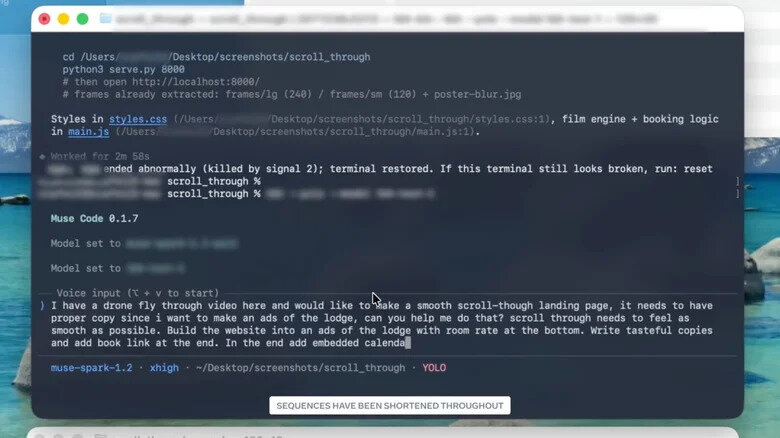
Meta Muse Code is a terminal-based coding agent powered by the new Muse Spark 1.2 model, introducing AI-assisted software development through natural language prompts. The tool supports code generation, complex debugging, codebase analysis, planning, and result validation while coordinating multiple sub-agents to complete development workflows. Meta demonstrated the platform through projects including an interactive photon sphere simulation, a Plants vs. Zombies-inspired game, and a webpage generated from an MP4 file, highlighting its ability to automate end-to-end engineering tasks.
Muse Spark 1.2 introduces improvements in code generation, debugging accuracy, and repository understanding while retaining pay-as-you-go pricing. Standard usage costs $1.25 per million input tokens and $4.25 per million output tokens, with a lower-priced contributor tier available for users who agree to provide feedback, reducing costs to $0.10 per million input tokens and $0.20 per million output tokens.
What's Driving This Trend
- Terminal-native AI Coding
- Command-line development environments gain new relevance as AI agents automate coding, debugging, and validation directly inside workflows already used by engineers.
- Multi-agent Software Automation
- Coordinated sub-agents create openings for more autonomous engineering pipelines that can plan, execute, test, and refine complex software tasks with less manual oversight.
- Usage-based Developer AI
- Pay-as-you-go token pricing and feedback-discount tiers make advanced coding intelligence more accessible to independent developers, startups, and enterprise teams experimenting at scale.
Who This Affects Most
- Software Development
- AI-assisted code generation and repository analysis reshape how teams build applications, reducing bottlenecks across prototyping, debugging, and maintenance.
- Developer Tools
- Terminal-based agents expand the competitive landscape for IDEs, command-line utilities, and DevOps platforms by embedding intelligent automation into core engineering interfaces.
- Artificial Intelligence
- Specialized coding models demonstrate how domain-focused AI systems can deliver higher-value automation for technical workflows beyond general-purpose chat interfaces.