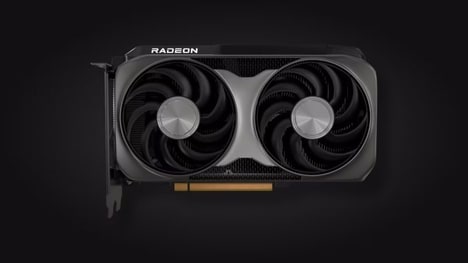
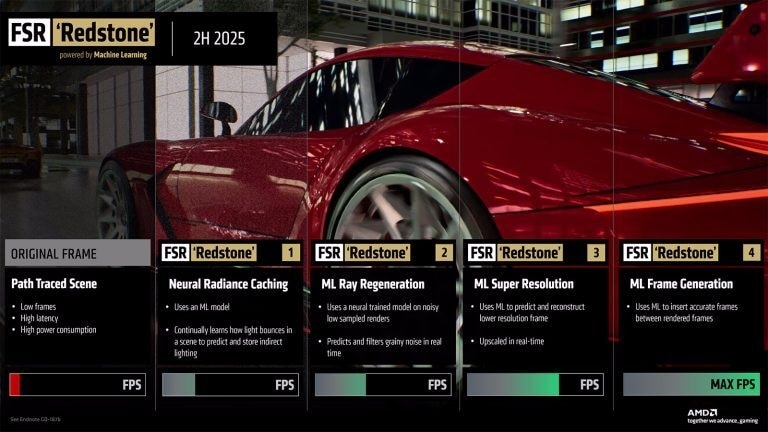
AMD’s FSR Redstone is presented as a suite of machine-learning–powered graphics technologies designed to improve performance and visual fidelity on supported GPUs, particularly the RDNA 4 family. The suite combines ML-based upscaling (FSR Upscaling), frame generation, ray regeneration to restore ray-traced detail from sparse samples, and radiance caching to predict and accelerate global illumination, with documentation and performance claims focused on enabling higher frame rates and enhanced image quality in compatible titles.
Reporting on the imminent launch describes Redstone as the most significant architectural update in the FSR line, highlighting three core innovations: an ML model for ray-trace denoising and reconstruction, neural radiance caching to learn and predict indirect lighting, and an evolved ML frame-generation model that integrates temporal and spatial awareness to create intermediate frames. The announcement timeline and early demonstrations suggest initial support will target recent high-profile titles and AMD’s latest GPU hardware, with further compatibility and implementation details to be revealed at the formal launch.
Image Credit: AMD
Key Themes Behind This Trend
- Ml-powered Graphics Upscaling
- Machine-learning–based graphics upscaling offers a breakthrough opportunity to enhance visual fidelity and performance across a wide range of GPUs.
- Neural Radiance Caching
- Implementing neural radiance caching leverages AI to efficiently predict and render realistic global illumination, transforming lighting effects in real time.
- Ray Trace Denoising Innovations
- Advancements in ray trace denoising through machine learning allow for granular reconstruction of light details, improving the quality of ray-traced visuals.
Where This Applies
- Video Game Development
- Adopting ML-powered graphics techniques can significantly enhance gaming experiences, influencing game design and visual storytelling in the gaming industry.
- Computer Hardware Manufacturing
- Integrating advanced graphics technologies in GPUs presents an opportunity for hardware manufacturers to differentiate products and drive market demand.
- Visual Effects Production
- Film and media professionals can employ ML-enhanced graphics solutions to push the boundaries of visual effects, achieving more realistic and detailed imagery.