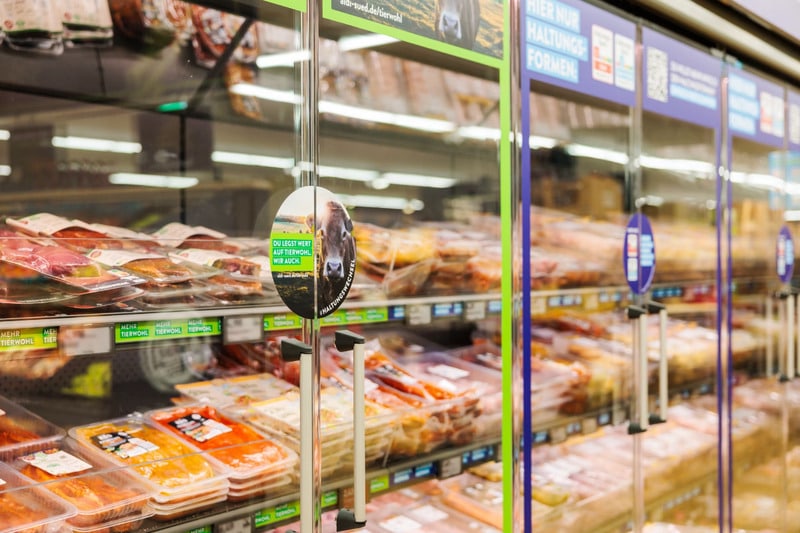
ALDI SÜD has implemented an innovative refrigeration reorganization strategy that fundamentally alters how animal products are displayed in stores by consciously centering animal welfare transparency. The German discount supermarket chain has restructured its fresh meat section. Now, the products are not grouped by protein type as it is traditionally done, but according to farming practice standards.
ALDI SÜD's pioneering visual system utilizes color-coded zones to create immediate visual differentiation of production methods and their animal welfare transparency. Blue signals conventional husbandry (Types 1-2), green is for enhanced welfare options (Types 3-5), and red is for standard offerings.
The initiative builds upon ALDI SÜD's existing commitment to source only higher-welfare fresh meat, dairy, and chilled meat products by 2030. This transition has already been completed for several product categories, including drinking milk and specific meat varieties.
Image Credit: ALDI SÜD
What's Driving This Trend
- Animal Welfare Transparency
- Retailers are enhancing meat product transparency through color-coded labeling, providing consumers with clear insights into animal farming practices.
- Refrigeration Reorganization
- Supermarkets are adopting innovative refrigeration layouts that emphasize ethical sourcing, shifting focus from traditional product categorization to welfare standards.
- Visual Differentiation Systems
- Color-coded visual systems are being used in retail to distinguish products based on production methods, offering a straightforward guide to ethical choices.
- Animal Welfare Transparency
- Retailers are enhancing meat product transparency through color-coded labeling, providing consumers with clear insights into animal farming practices.
- Refrigeration Reorganization
- Supermarkets are adopting innovative refrigeration layouts that emphasize ethical sourcing, shifting focus from traditional product categorization to welfare standards.
- Visual Differentiation Systems
- Color-coded visual systems are being used in retail to distinguish products based on production methods, offering a straightforward guide to ethical choices.
Who This Affects Most
- Grocery Retail
- The grocery sector is innovating by integrating animal welfare-centric product displays to align with evolving consumer values.
- Refrigeration Technology
- Advancements in refrigeration technology enable retailers to create modular layouts that highlight sustainable and ethical product selections.
- Sustainable Agriculture
- There is a growing industry demand for transparently-sourced agricultural products, driven by consumer interest in sustainability and welfare practices.