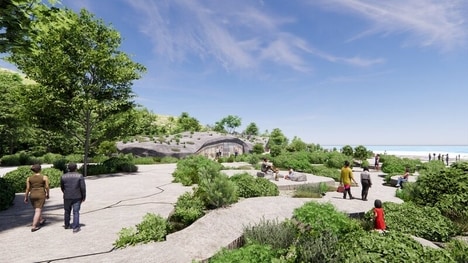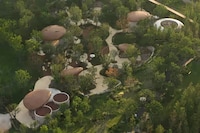
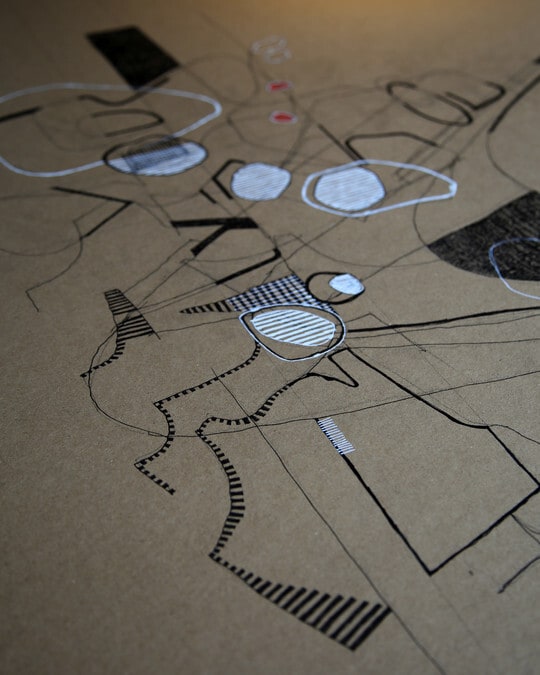
At the Royal Danish Academy's ‘Imagining Futures through Architecture and Design’ exhibition, Jacob Sebastian Bang and Anne Romme presented Wetlands. The design project used drawings, collages, and reliefs to explore the island as a symbol of future settlements in a flooded world.
Ultimately, Wetlands proposes a self-sufficient architecture interwoven with geology and nature that embraces unpredictability and transformation. As se levels rise during climate change, many coastal communities will need to adapt or relocate, but most architectural responses have focused on defensive strategies like seawalls or on retreating inland. etlands offers a different vision, one where buildings are not objects placed on top of land but living dynamics that merge with wetlands, marshes, and water, allowing human settlements to coexist with flooding.
Ultimately, the project's exploration of scales from bacterial colonies to wide-open spaces dissolves the traditional boundary between nature and culture.
Image Credit: Anne Romme
Why This Trend Is Growing
- Living Architecture
- Buildings conceived as living systems that integrate geology, vegetation, and water to enable self-sufficient habitations within dynamic wetland environments.
- Adaptive Island Settlements
- A shift toward settlement models that accept periodic inundation and leverage buoyant, flexible, and modular forms to maintain continuous occupancy.
- Nature-culture Integration
- Design approaches that dissolve the boundary between ecological processes and human use, creating multifunctional landscapes that support biodiversity alongside habitation.
Industries Being Reshaped
- Coastal Urban Planning
- Planning practices focused on zoning, infrastructure, and community design that prioritize coexistence with rising waters and evolving shoreline morphologies.
- Wetland Construction Materials
- Material science and manufacturing oriented toward biodegradable, buoyant, and water-tolerant building components tailored for marsh and flood-prone contexts.
- Ecological Engineering
- Engineering services that combine habitat restoration, hydrology, and built systems to produce resilient mixed-use environments in transitional aquatic-terrestrial zones.