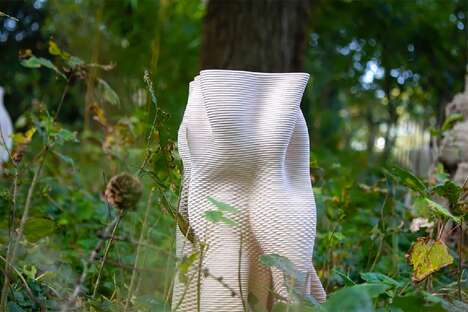
'Hardshell Labs' recently teamed up with Tatjana Dzambazova from the 3D software company 'Autodesk' to design a series of 3D-printed tortoise shells. However, these high-tech shells are not intended to replace damaged ones, but rather to act as decoys that will confuse the tortoise’s worst predator.
Dzambazova and the team at Hardshell Labs came up with the idea of using 3D printing technology to give young dessert tortoises a better chance at survival. To do so, they printed a number of decoy tortoise shells and coated them with a non-toxic spray. The spray trains ravens not to attack the tortoises, while sensors inside the shell track how many birds are deterred by the decoys. The goal is to change the behavior of the ravens so that they will eventually abandon the tortoise as a food source entirely.
While the project is still in the early stages, the researcher's efforts demonstrate how 3D-printing can have beneficial applications to the animal world.
Key Themes Behind This Trend
- 3d-printed Decoy Shells
- There is a potential for disruptive innovation in the field of wildlife conservation with the use of 3D-printed decoy shells.
- Non-toxic Animal Deterrents
- The development of non-toxic sprays as a method for changing animal behavior has potential for disruptive innovation in pest control.
- Sensor Technology for Wildlife Research
- The use of sensor technology in wildlife research offers potential for disruptive innovation in animal behavior studies.
Where This Applies
- Wildlife Conservation
- The use of 3D printing for wildlife conservation efforts has the potential to revolutionize traditional methods of animal protection.
- Pest Control
- The development of non-toxic sprays as a method for changing animal behavior could be a game-changer in the pest control industry.
- Animal Research
- The use of sensor technology in animal research may potentially pave the way for innovative methods of studying animal behavior and ecology.