The Light House by Studioninedots is a 257-square-metre residence in Amsterdam organized as a vertical stack of distinct living volumes. The project was designed by Dutch architecture studio Studioninedots and completed in 2025 on Centrumeiland. Each major household activity, including cooking, dining, and relaxing, is assigned to its own spatial “box,” arranged within a compact footprint to form a multi-level structure.
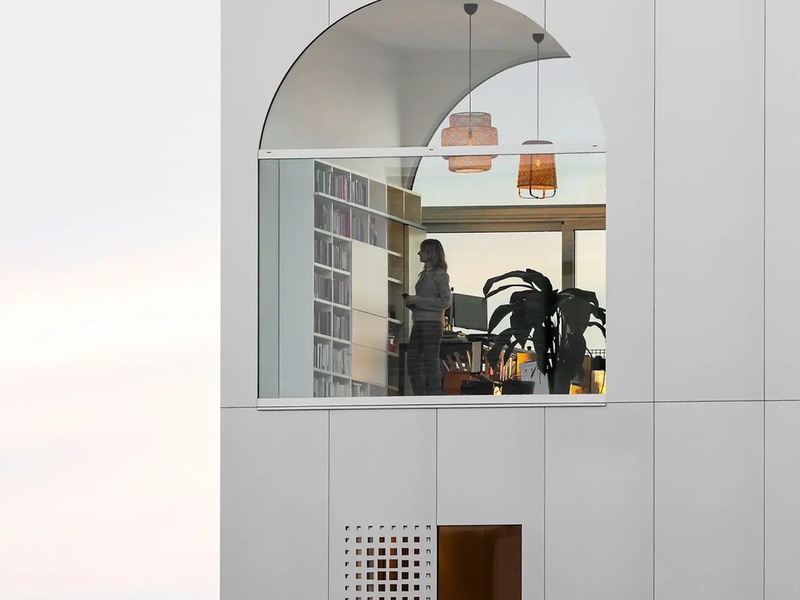
The layout replaces a conventional floor plan with a sequence of stacked and interlocking volumes connected through open passages and voids. Smaller enclosed areas provide separation, while larger openings maintain visual connections across levels. A top-floor gathering space rises approximately 14 metres and features arched openings with views across the IJmeer. The structure uses a steel frame with prefabricated timber components and incorporates a glass block facade that filters daylight while obscuring direct views.
Image Credit: Studioninedots
What's Driving This Trend
- Vertical Stacked Living
- The concentration of distinct household functions into stacked volumes creates new possibilities for high-density family housing models that rethink vertical circulation and privacy.
- Box-based Spatial Modularity
- Interlocking prefabricated boxes suggest a shift toward customizable, reconfigurable home units that can be combined or replaced to adapt to changing household needs.
- Daylight-filtering Facades
- Use of translucent glass block systems highlights demand for facades that balance daylighting, thermal performance, and visual privacy in dense urban contexts.
Who This Affects Most
- Residential Architecture
- Design practices focused on multi-level, family-oriented dwellings may explore new programmatic zoning and vertical community typologies that challenge conventional floor plans.
- Prefabricated Construction
- Manufacturers of modular timber and steel components are positioned to deliver faster, more precise assembly methods for complex stacked geometries.
- Façade Materials Manufacturing
- Producers of translucent cladding and integrated glazing systems could innovate products that combine daylight control, acoustic insulation, and occupant privacy in a single envelope.