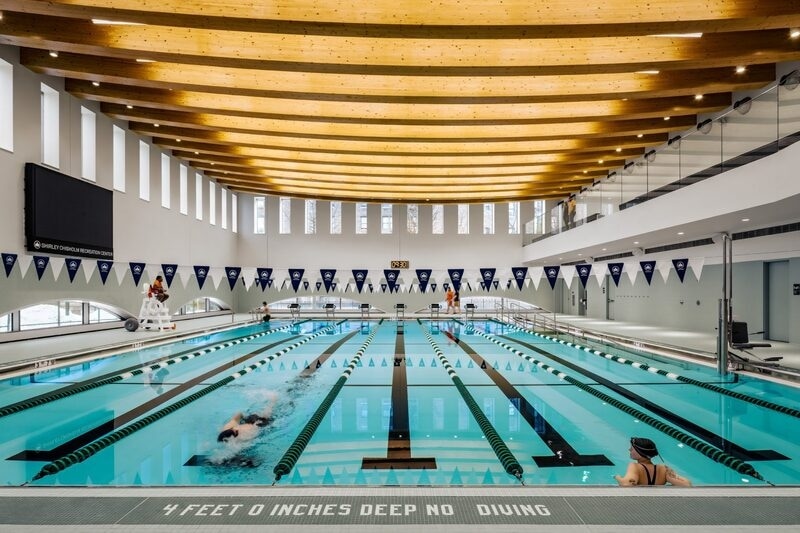
The Shirley Chisholm Recreation Center project in Brooklyn is an expansion and redesign of an existing community facility led by architecture firm Studio Gang. The work includes the addition of new program spaces, reconfigured circulation, and exterior improvements to support recreational and athletic uses. The expanded facility provides areas for sports, fitness, and community activities within the site’s footprint adjacent to public open space.
The architectural design integrates structural additions that align with the existing building’s scale while accommodating larger interior volumes for courts and gathering areas. Facade modifications include updated cladding and window systems to improve daylight penetration and visual connection between interior spaces and exterior activity zones. Interior finishes are selected for durability in high-usage areas, and mechanical systems are upgraded to meet current performance standards. The project also updates site access and landscaping to support pedestrian movement around the complex.
Image Credit: Alexander Severin
Key Themes Behind This Trend
- Adaptive Reuse of Community Facilities
- Repurposing existing recreation centers into mixed-volume, multi-program hubs that preserve scale while adding new sports and social spaces creates opportunities to rethink community building lifecycle and asset efficiency.
- Daylight-oriented Façade Retrofits
- Façade upgrades that emphasize increased daylight penetration and visual connectivity enable new performance-driven cladding and glazing systems tailored for high-occupancy civic uses.
- Integrated Indoor-outdoor Recreation Design
- Design strategies that blur interior and exterior activity zones around adjacent public open space open possibilities for seasonal, scalable programming and hybridized facility footprints.
Where This Applies
- Architectural Design Firms
- Specialist practices focused on scalable additions and sustainable retrofit strategies can redefine how public facilities balance heritage context with modern program demands.
- Building Materials Manufacturing
- Durable, high-performance interior finishes and modular façade components designed for heavy-use civic settings present a market for long-life, low-maintenance product lines.
- Smart Building Systems
- Upgraded mechanical and circulation systems in recreation centers create demand for integrated sensor-driven HVAC, occupancy management, and environmental controls optimized for variable-intensity athletic and community uses.