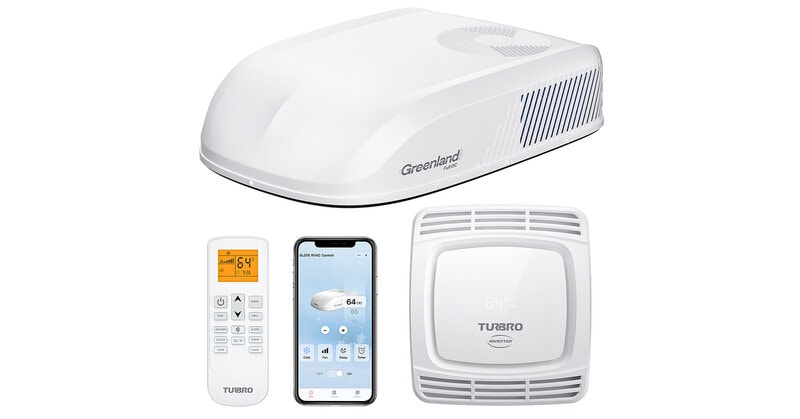
TURBRO's Greenland GLD15 brings direct 48V DC rooftop cooling to RVs built around higher-voltage battery banks, removing the external inverter step. That native DC setup is framed as a 25% thermal-efficiency gain, giving off-grid owners a way to run climate control with less energy lost in power conversion.
The rooftop unit delivers 15,000 BTU of cooling and also works as a heat pump, folding summer AC and cooler-weather heating into one piece of hardware. Because it is made for compatible 48V systems, it suits owners who are already upgrading their rigs for longer boondocking trips and custom electrical layouts, instead of treating high-demand cooling as an add-on.
Native 48V operation turns rooftop air conditioning into a cleaner match for RVs that already use lithium banks and solar charging. Available through TURBRO, the GLD15 widens DC climate control by treating higher-voltage builds as a design target instead of a workaround.
Image Credit: TURBRO
What Makes This Trend Stand Out
- Native DC Climate Control
- Rooftop cooling systems designed around direct battery power reduce conversion losses and support more efficient off-grid comfort in mobile living environments.
- 48V RV Electrification
- Higher-voltage battery architectures are reshaping RV appliance design by making energy-intensive systems more practical for solar-supported travel.
- Integrated Heating-cooling Units
- Combined heat pump and air conditioning hardware creates compact climate solutions that suit space-limited vehicles with seasonal comfort needs.
Sectors Adopting This
- Recreational Vehicles
- RV manufacturers have room to differentiate through factory-ready 48V electrical ecosystems that align major appliances with longer boondocking use cases.
- Mobile Energy Storage
- Lithium battery and solar providers can benefit from climate-control loads becoming core design considerations in high-capacity off-grid power systems.
- HVAC Equipment
- Compact DC-powered HVAC platforms point to new product categories built for vehicles, cabins, and other distributed spaces beyond conventional grid-tied buildings.