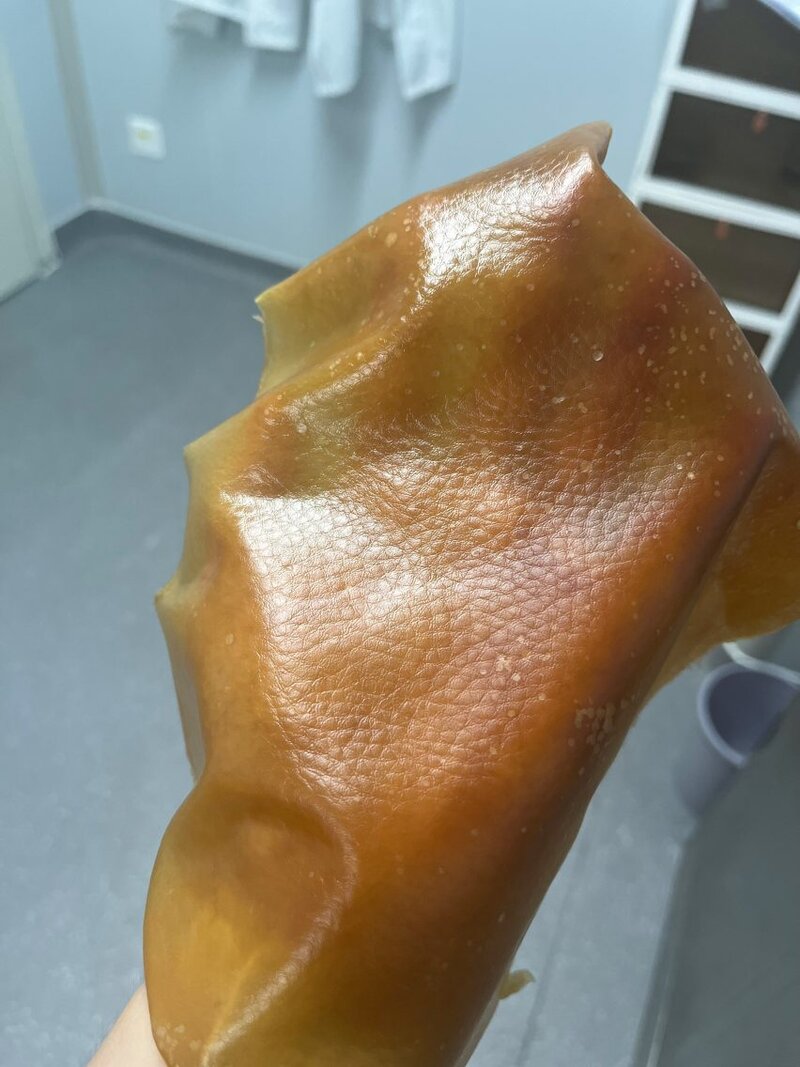
Researchers at the Shenzhen Institutes of Advanced Technology have developed a living fungal textile built from dormant Cordyceps militaris mycelium that remains biologically active after fabrication. Unlike conventional mycelium materials that are dried to stop growth, the engineered material enters a low-metabolic dormant state and can be reactivated with a potato-based nutrient solution. New fungal filaments regenerate the surface, enabling localized repair with fresh mycelium patches, while the naturally hydrophobic structure also provides self-cleaning properties. The researchers describe the system as a programmable platform that accepts additional fungal or yeast cultures to introduce new functions without genetic engineering.
Brewer's yeast produces stable blue pigmentation, while Aspergillus niger contributes ultraviolet protection through a modular co-culturing process. The material is fabricated as flexible sheets that can be cut and formed into textiles or molded objects, including prototype containers and accessories. Berlin-based material innovation company Peelsphere demonstrated the technology through a conceptual dress incorporating multiple fungal formulations.
Image Credit: Ke Li
What's Driving This Trend
- Living Biomaterial Platforms
- Programmable organisms embedded into materials create adaptive surfaces that can repair, protect, and evolve beyond the limits of static synthetic textiles.
- Dormant Mycelium Textiles
- Low-metabolic fungal structures introduce a new class of reactivatable fabrics with potential for localized regeneration, self-cleaning performance, and reduced material waste.
- Modular Biofunctioning
- Co-cultured fungi and yeast enable material properties such as pigmentation and UV resistance to be added through biological compatibility rather than genetic engineering.
Who This Affects Most
- Sustainable Fashion
- Living fungal fabrics offer designers biodegradable, repairable, and functionally customizable alternatives to petroleum-based textiles and chemical finishing processes.
- Advanced Materials
- Bioactive sheets that can be molded, cut, and reprogrammed expand the commercial potential of regenerative materials across packaging, accessories, and product design.
- Biotechnology
- Non-genetically engineered microbial co-culturing presents a scalable pathway for developing adaptive materials with embedded color, protection, and maintenance capabilities.