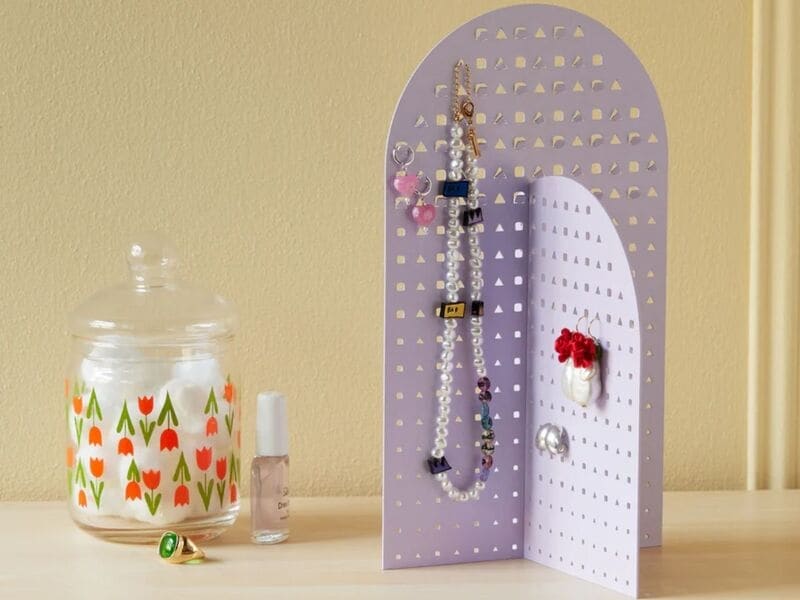
The Modern Geometry Jewelry Stand is a sculptural jewelry display object designed by Nihaarika Arora and produced exclusively for the MoMA Design Store. The stand consists of two interlocking powder-coated iron panels that assemble without fasteners into a three-dimensional structure. Its form references modernist spatial logic, using geometric planes and rhythmic perforations to create a stable framework that can exhibit bracelets, necklaces, earrings, and rings.
Perforations across the panels allow stud earrings to pass directly through the surface, while integrated hooks support hanging pieces such as necklaces and bracelets. The design gives each item its own visual field, treating accessories as part of a curated composition rather than mere storage items. Material tests and iterative prototypes informed choices around iron thickness, balance, and detailing to achieve both structural strength and visual lightness.
Image Credit: Nihaarika Arora
Why This Trend Is Growing
- Sculptural Merchandising
- Retail environments are shifting toward display objects that double as art pieces, creating opportunities for products that elevate buying experiences through form-driven presentation.
- Toolless Interlocking Systems
- Modular assembly methods that eliminate fasteners are enabling lightweight, transportable structures that redefine customization and on-site adaptability for temporary and permanent installations.
- Material-informed Iteration
- Designs guided by hands-on prototyping and material testing are producing functional objects with refined balance and perceived lightness, challenging expectations around durability and aesthetics.
Industries Being Reshaped
- Retail Merchandising
- Display-first approaches are prompting retailers to consider fixtures as brand statements, influencing product curation, spatial storytelling, and in-store engagement metrics.
- Museum and Exhibition Design
- Curatorial settings are increasingly valuing modular, sculptural mounts that integrate conservation needs with visually compelling narratives for diverse collections.
- Home Decor and Interior Products
- Consumers are gravitating toward multifunctional decorative objects that serve as both storage and sculptural focal points, shifting demand toward designer-led, small-batch furnishings.