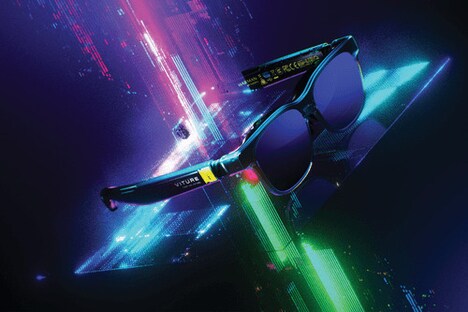
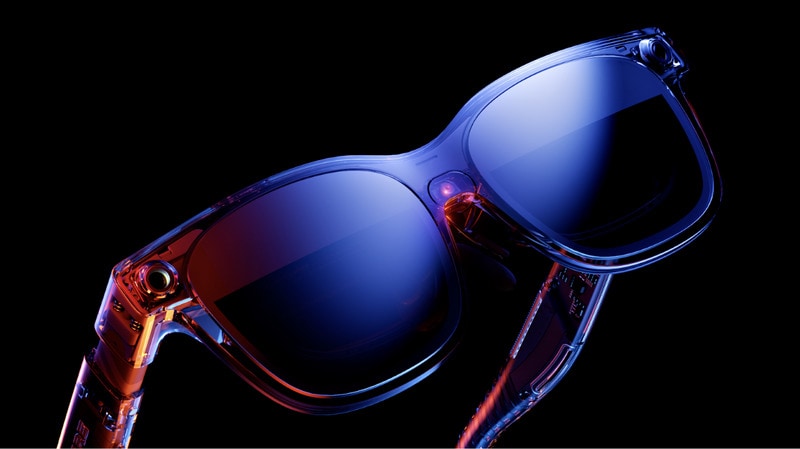
VITURE’s Luma series comprises three XR glasses models—Luma, Luma Pro, and Luma Ultra—each built around Sony micro-OLED displays that deliver a “4K-like” experience. The entry-level Luma ($399) offers a 146-inch virtual screen, 50° field of view, up to 1,000 nits of brightness, and three-degrees-of-freedom tracking. The Luma Pro ($499) increases the virtual screen to 152 inches, expands the field of view to 52°, adds dynamic electrochromic dimming, magnetic nose pads, top-mounted control dials, and is optimized for gaming across platforms such as Nintendo Switch 2, Steam Deck, and PC. At the top of the Luma lineup, the Luma Ultra ($599) incorporates a triple-camera array—RGB and dual depth sensors—for six-degrees-of-freedom tracking and gesture recognition, positioning it for enterprise applications like AI training, virtual walkthroughs, and spatial collaboration.
The Beast is VITURE’s flagship XR glasses, priced at $549, and designed to maximize immersive scale and visual fidelity. It employs Sony’s next-generation micro-OLED panel to produce up to a 176-inch virtual screen with a 58° field of view and peak brightness of 1,250 nits. The Beast retains three-degrees-of-freedom tracking, dynamic electrochromic dimming, and an ergonomic form factor while omitting depth cameras to ensure optical stability. Targeted at personal cinema, productivity, and gaming, The Beast connects via USB-C to consoles, PCs, and mobile devices, delivering a compact spatial computing platform with flagship display performance.
Image Credit: VITURE
What Makes This Trend Stand Out
- Enhanced Visual Fidelity in XR Glasses
- Advancements in micro-OLED display technologies enable XR glasses to offer a '4K-like' experience, enhancing user engagement through improved visual fidelity and broadening the application scope from gaming to enterprise solutions.
- Dynamic Dimming and Customized Fit
- Incorporating features such as dynamic electrochromic dimming and customizable ergonomic design in XR glasses adapts to varied lighting conditions and user preferences, promoting longer and more comfortable use in diverse environments.
- Gesture Recognition and Spatial Collaboration
- Integration of triple-camera arrays for gesture recognition in XR glasses provides an opportunity to enhance interactive and collaborative experiences in enterprise contexts, paving the way for intuitive AI training and virtual walkthroughs.
Sectors Adopting This
- Wearable Technology
- The development of multifunctional XR glasses suggests significant growth in the wearable tech industry, with innovations offering versatile applications for both personal and professional use.
- Gaming and Entertainment
- The compatibility of XR glasses with gaming platforms and their ability to deliver immersive cinematic experiences amplifies opportunities within the gaming and entertainment sectors.
- Enterprise Software and Services
- With XR technology facilitating AI training and spatial collaboration, there's potential for disruptive growth in enterprise software, particularly in developing tools that enhance remote and interactive workflows.