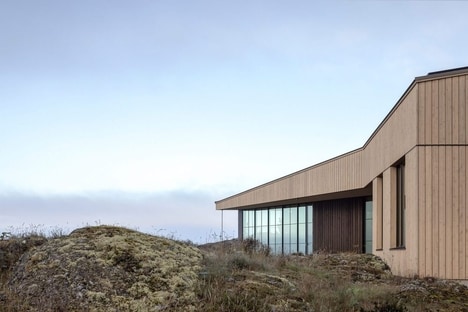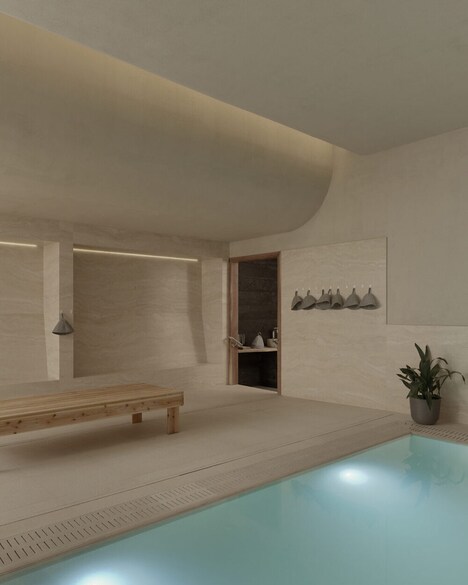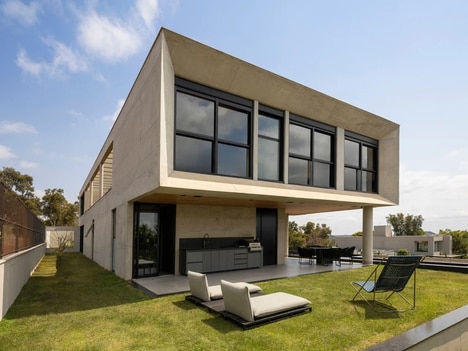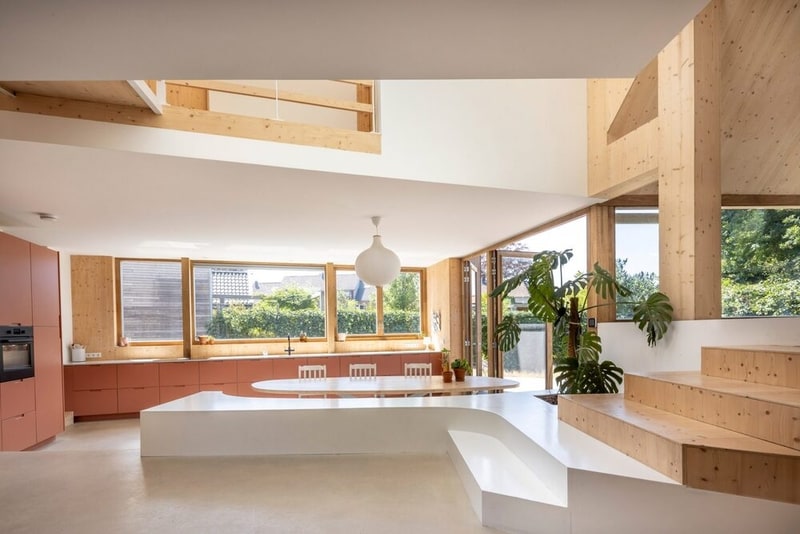
The Light House by Woonpioniers is a residential project in the Netherlands organized around a central void that draws daylight deep into the interior. Dutch studio Woonpioniers restructures a traditional house layout by carving out a vertical light well, allowing natural light to reach multiple levels. The interior is lined almost entirely in timber, creating a continuous surface that wraps walls, ceilings, and built-in elements across the space.
The layout is arranged with rooms positioned around the central opening, using the void as both a circulation anchor and a light source. Openings between levels create visual connections across floors, while glazing and cut-outs control how light enters each space. The exterior maintains a restrained, traditional profile, contrasting with the more contemporary interior intervention. The structure combines standard residential construction with inserted timber volumes that define storage, staircases, and room boundaries.
Image Credit: Woonpioniers
Key Themes Behind This Trend
- Central Light Voids
- A vertically carved central void that channels daylight deep into multi-level homes enabling new spatial programs that prioritize daylight distribution over traditional room adjacency.
- Timber Wrapped Interiors
- Continuous timber linings that unify walls, ceilings, and built-ins create a warm, monolithic interior surface that shifts expectations for material performance, finish integration, and acoustic behavior.
- Circulation-as-anchor
- Arranging rooms around an open circulation core that functions as both a light source and social spine reframes movement through the home as a design driver rather than a residual necessity.
Where This Applies
- Residential Architecture
- Design practices centered on reconfiguring traditional house typologies toward internalized light wells and visual connectivity offer opportunities to redefine density, privacy gradients, and occupant well-being metrics.
- Prefabricated Timber Manufacturing
- Modular timber volumes for integrated storage, staircases, and surfaces promise shifts in construction workflows by combining structural, interior, and finish components into factory-made assemblies.
- Lighting Design and Controls
- Daylight-focused strategies paired with calibrated glazing and cut-outs create demand for hybrid lighting systems that blend architectural apertures with dynamic artificial controls to optimize comfort and energy use.