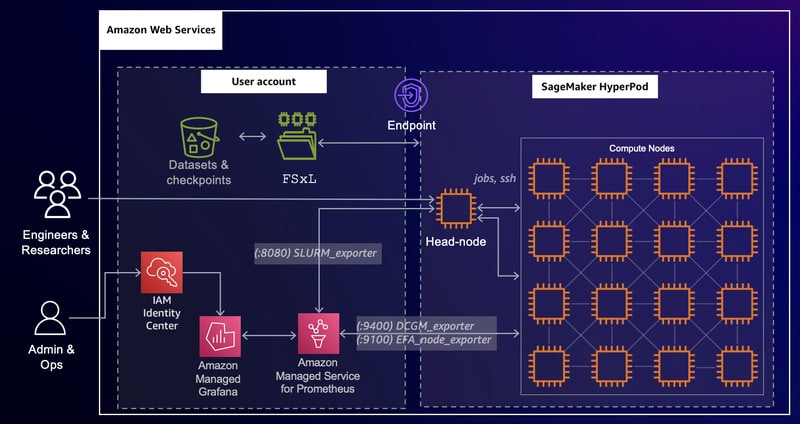
Fundamental, a San Francisco startup, introduced Nexus, a large tabular model designed to interpret spreadsheet and table data, featuring training on billions of tabular datasets and deployment via Amazon SageMaker HyperPod. The team—built by alumni of Google's DeepMind—positioned Nexus as a foundation model optimized for non-sequential, relational data common in enterprises.
Nexus was unveiled alongside $255 million in funding and an AWS partnership, and the company said the tool integrates into customer data stacks to begin learning patterns automatically with no manual training. The model handles non-linear interactions across rows and columns and aims to support predictions ranging from fraud detection to hospital readmission and energy pricing.
For businesses, Nexus promises faster, data-driven decisioning by applying deep learning to structured data, addressing a gap where LLMs underperform and reflecting a broader trend toward domain-specific foundation models.
Image Credit: AWS
What's Driving This Trend
- Domain-specific Foundation Models
- A shift toward foundation models tailored to particular data types enables specialized inference and feature extraction that outperform generalist models on enterprise workloads.
- Automated Structured-data Learning
- Models that ingest and learn from tabular data with minimal manual labeling create continuous, self-improving data layers that can surface latent correlations across organizational datasets.
- Relational Deep Learning at Scale
- Scalable architectures designed for non-sequential relationships across rows and columns allow complex, non-linear interaction modeling previously impractical for large enterprise tables.
Who This Affects Most
- Financial Services
- Fraud detection, credit scoring, and risk modeling stand to be transformed by large tabular models that can integrate heterogeneous transactional and customer tables for real-time scoring.
- Healthcare
- Patient outcomes and readmission risk predictions could improve through models that jointly reason over EHR tables, lab results, and billing data to reveal cross-domain patterns tied to care quality.
- Energy and Utilities
- Dynamic pricing, demand forecasting, and grid reliability analytics may benefit from models that capture complex interactions among temporal, geospatial, and asset-management tables at fleet scale.