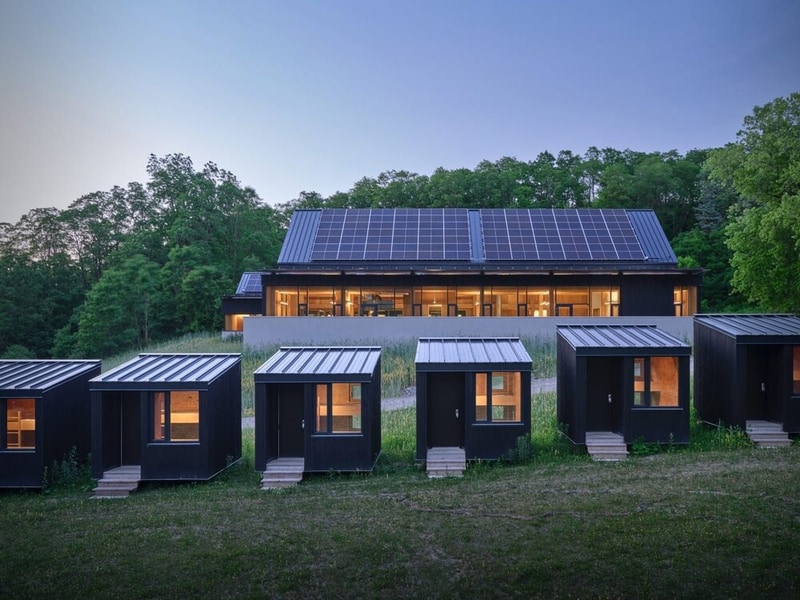
The University of Toronto Koffler Scientific Reserve building by Montgomery Sisam Architects is a research and teaching facility located within the university’s ecological field station in King Township, Ontario. The University of Toronto Koffler Scientific Reserve building was designed as a hub for ecology and environmental biology programs and replaces several aging farm structures previously used for student housing and research spaces.
The project consolidates classrooms, dormitory accommodation, and communal areas within a 2,680-square-metre mass-timber complex set among forests, wetlands, and grasslands that form the reserve’s 348-hectare landscape.
Two pitched-roof volumes connected by a low base form the main structure, drawing inspiration from the agricultural barns historically found across the region. The building uses exposed mass timber construction and shou sugi ban charred wood cladding, while solar orientation, natural ventilation, and photovoltaic panels support a net-zero energy and carbon strategy. Shared spaces including a dining hall, classroom, and student commons occupy the central volume
Image Credit: Doublespace Photography
What's Driving This Trend
- Mass Timber Adoption
- Rapid growth in exposed mass timber construction is creating opportunities for novel structural systems that reduce embodied carbon and enable faster on-site assembly.
- Net-zero Educational Facilities
- Educational campuses emphasizing net-zero energy and carbon strategies are prompting integration of on-site renewables and passive design into institutional building typologies.
- Barn-inspired Bioclimatic Design
- Heritage-inspired pitched forms combined with solar orientation and natural ventilation are enabling hybrid designs that marry vernacular aesthetics with high-performance environmental control.
Who This Affects Most
- Higher Education
- Campus planning that consolidates research, housing, and teaching spaces within sustainable timber complexes is reshaping lifecycle budgeting and facility procurement models.
- Prefabricated Timber Construction
- Off-site engineered mass timber systems are altering supply chains by enabling modular delivery, reduced waste, and faster erection schedules for mid-rise institutional buildings.
- Sustainable Energy Systems
- Integration of photovoltaics, passive ventilation, and net-zero operations in research facilities is driving demand for distributed energy management and grid-interactive building technologies.